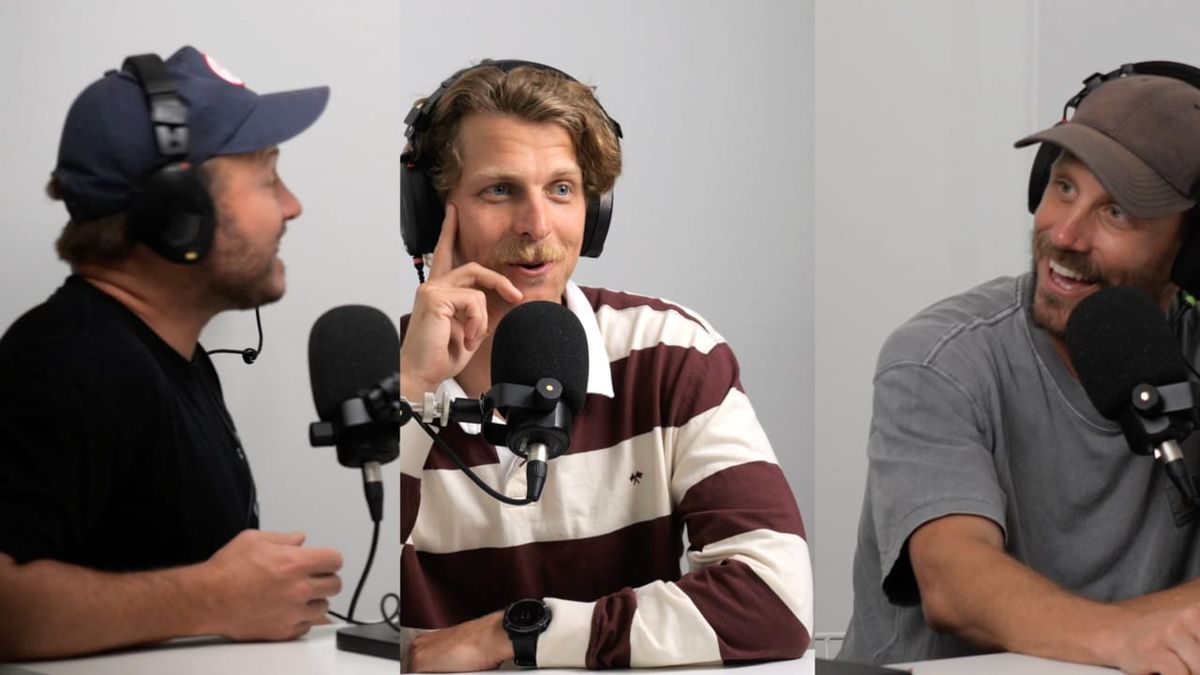
Mick Kelly cried at a YouTube video of 75-year-olds finishing an Ironman. Now he's signed up to run 200 miles around Lake Tahoe.
Mick Kelly from We Got The Chocolates is the first guest to sit in this studio as a third host rather than an interview subject — which is fair enough, given he does this for a living. He and Liam met in a Gold Coast physio's waiting room, both there for a massage, and have been running together since.
What follows is one of the better accounts of how someone ends up at the deep end of endurance sport without ever being an athlete. Tenth in his grade at school cross country. Crying at a YouTube compilation of 75-year-olds finishing Ironman. A marketplace bike, a fall at 4:30am still clipped in, a six-and-a-half-hour 70.3, and a 5:02 marathon leg in Cairns that he calls one of the best days of his life.
Now it's 200 miles at Tahoe, and he can't fully explain why beyond wanting to feel every emotion there is. Courtney and Liam push on that, and on the medal Sydney had to apologise for.
In this episode
- How Mick and Liam met — a Gold Coast physio's waiting room, and a very ordinary start to a friendship
- We Got The Chocolates from a 2019 side project between schoolmates to a full-time job
- The odds game that broke the show, why Mitch went through with it, and the doctors who emailed in begging him not to
- The YouTube video of 75-year-olds finishing Ironman that started all of this
- A 6.5-hour 70.3, then Cairns: four laps and a 5:02 marathon leg he'd do again tomorrow
- Why running won out over the swim and the bike, and Courtney on the TT bike that got stolen and recovered
- Signing up for 200 miles at Tahoe after missing the Cocodona lottery
- Liam on his wife explaining the amygdala to their ten-year-old — a tiger behind you versus a stage in front of you
- Choosing a human coach over an AI one, purely for accountability, then sleeping through session two
- Sydney's medal blunder: Allianz Arena in Munich etched instead of Allianz Stadium, and why the response was handled well
- Steve Jackson's trail-series finisher gifts, and the case for a crown over a medal
- Filming himself vomiting at 26k of the Rainbow Beach Marathon and posting it anyway
- Speedgoats to Altras, the Border Bolt course he got lost on, and the run-club shirt rule
- Matt Hauser's LA build, Alex Yee, and Mondo Duplantis releasing a song
Timestamps
- 0:00 — Meet Mick Kelly
- 1:32 — A physio waiting room
- 6:11 — The odds game that broke the show
- 10:51 — Crying at an Ironman video
- 12:26 — A 6.5-hour 70.3, then Cairns
- 17:06 — Why running beat swim and bike
- 20:10 — Why 200 miles
- 26:17 — The amygdala talk
- 30:52 — A coach over an AI
- 35:32 — The Allianz Arena medal
- 40:15 — The vomit video at 26k
- 54:24 — Mondo releases a song
Listen
Related In The Beginning episodes
- Liam Flanagan's UTA Miler: No Sleep, He Finished The Damn Thing
- 160k To Go: Liam's Last Chat Before UTA | EP 86
- Holly Ranson On The Mindset Of Ultra Running | EP 77
- Trail Running Tips | EP 28
Related reading: what the Tahoe 200 actually asks of you — the finisher data behind the race Mick has entered.
Full transcript
Auto-generated transcript, lightly edited for clarity.
Read the full transcript
[00:00] In the beginning, episode 102. Courtney Atkinson, how are you? I'm good, Liam Flanagan — but we've got a true pro. You're the secondary pro. Special episode. We actually haven't done this before. We have had guests join the studio — we've had Ash Gentle and Josh Amberger in here, we've had Matt Hauser, we've had Andy Buchanan, Holly Ranson. We've had some incredible— This isn't going anywhere good, Liam, at the moment. No, no, no, I mean that we have a co-host essentially for today, because we've brought in someone who we wanted to talk to about running, but also this is their job. They are a professional podcaster, and we've gone straight to the top of the tree. We Got The Chocolates podcast — the one and only Mick Kelly. Good morning. Thanks for having me. Look, I mean, it is what I do, but my role usually on a podcast is to laugh and say dumb things and not be that good at talking. So you're in for a— You've got your work cut out. Laugh and say dumb things — that's my job on this show. So you're gonna need to find something else to do. Okay, cool. But straight up off of that — how the hell did you two get— so you've been running together? This has come out of the blue to me, on the blind side. I'm gonna have to be the ref in here today, between the podcaster and the radio. This is a real— real "how we met": we're both getting massages.
[01:32] Trent. Gold Coast physio. Yes. Liam walked out after getting his massage, I'm sitting in the waiting room, and Trent looks at me and goes, "Oh, two podcasters!" He recognised Liam, and we just started chatting a little bit, and that was that. Yeah, and so Mick messaged after the miler, of course, as well. Then after we did the miler, Mick had had a listen to that, and lives nearby to me, so we started going for a few runs. Because then obviously part of it for you is that you've got a miler coming up very soon. So to see an average— to see a hobby jogger like me go through it, it's given Mick all the motivation he needs. Yep. Similar times, I think, we'll probably do. Nah, you will not do 38 hours for it. Kosci, right? I'm doing Kosci, so it is an easier course. It's easier, isn't it? But it's nothing easy. There's no stairs. How are you feeling about the Kosci? Good. And there is a reason I am feeling good about it. I will probably get into it, but it's because of a race I have next year, which is 200 miles. So in my head, 100 miles seems really easy — which is the worst way to think when it comes to running 100 miles. I've never done it, obviously. What has got you going to the 200 miler? Because it's too high. Yeah, I hope to wander again June next year. No — like, I genuinely don't know. I wanted to do Cocodona, and went through the lottery and everything and didn't get in, which I think was like a 15% chance I was gonna get in the first year.
[03:07] So didn't have huge hopes for it. But I don't know. I don't know. I really wish— I just, why not? I just give it a crack. Like, I've been running for a while now — it's not like I've just gone from nothing to doing 200 miles. Is this you attempting to make sure we don't classify you as one of these influencers that is trying to jump on the running bandwagon here? Trying to show your bona fides that— no, running for ages, mate. Back to 2019 or something like that. I wanna get across your running history a little bit. Did you run at school? Like, were you— 'Cause that's where— sorry, go again. We Got The Chocolates — you're just a bunch of schoolmates, aren't you? Yeah, essentially, yeah. So Lee was a few grades above me, he was mates with my brother; Mitch, or Skin, he was a few grades below. And so I kinda knew them from when I'm really about 6 or 7 years old. And they just brought me in one time to film some stuff for them after they'd started the podcast, and I was just sitting there listening, just going, "This is hilarious. Like, this could actually be all right." And then, you know, we just started filming things and it just went— yeah, it went well. So how long's the podcast now? How long have you guys been doing it? They started it in 2019, I wanna say. Okay. And they just did it 'cause they loved it, which you have to do with a podcast. Like, you can't start it going, "This is our job now." And so probably 2020 I jumped in to help film a few things, and then probably 2021 was when they started making a bit more money, and then 2023— well, we all went full time, or 2024, yeah.
[04:40] So, I don't know, it was a— I don't know what the question was, but— Well, now— yeah, yeah. We do as many podcasts a week as you guys. We do the rest of the week. But yeah, we recorded on Monday. So I was full time for the last few years and I've just stepped back a little bit, to really work on my running career. It's just— it's in Brisbane. I live on the Gold Coast, and you live on the Gold Coast for a reason. The lifestyle is amazing. So I just didn't want to be in Brissie every day. Yeah. So Monday we record the pod, and for us it's all about the content, day to day. Like, we're posting other videos, YouTube videos — there's so much to do. Which, it seems like— if you have seen the videos, like, we play office cricket two hours a day. But it's content, yeah. You're part of the problem though. We Got The Chocolates. No, it is. It's part of the problem. Because people watch this and go, "Oh, our mates— we'll play cricket in the office. Let's start a podcast." And I would say you guys are the exception to the rule, as in genuine success story: you've taken a friendship and turned it into a business that allows you to just keep being friends day to day. Yeah, absolutely. And I think it goes back to, you've just got to start it because you just want to do it.
[06:11] Yeah, because you love catching up and having a yarn. And I think the thing now, because we have built that kind of following and everything, we can kinda do more of that stuff. Like, we started doing office cricket videos. Actually, with social media now — who knows? Who knows? This is day one, I'm just trying to bowl a perfect maiden over in office cricket. Was there like one period, or one thing, that kind of just made it pop? It kind of went from, like, "It's going well, it's going well," and then it just banged. Yeah, there's one moment. I think if you've seen the videos you probably know, but— the odds game, which I don't know if you're familiar with, or— Yeah. So, what are the odds that you run a marathon? You say, "Oh, 1 in 10." You count down three, two, one, and you've got to say the same number between 1 and 10. If you say the same number, you have to do that thing. For Mitch on the podcast it was: what are the odds that you would get a Prince Albert — which is essentially a piercing in the penis. He said 1 in 50, which was— not like 20, 50. And they both said 27, and it was just the reaction, like, from us. Like, we had to stop filming. It was just 20 minutes of just, like — I wee'd my pants laughing, we were all crying. And people come to us all the time in the house still saying, "Was that scripted? Was that fake?" And was there a conversation after that about, "I can't actually do—"
[07:43] Yeah. But he wasn't the one saying that — the rest of us were saying, "Don't do it." Like, hilarious for them, like for the video, great — no one's expecting it. He's like, "No, no, I think I should do it. Like, I lost the odds game." And I'm like, I have so much more respect for you now. But it's funny, because out of the three of us, he's probably the least likely to go ahead. Like, you might do it — like, that's it, we're now— but like, it's... Yeah, yeah. Okay. And then— so you got some solid rules around... how long? As in— Sorry, no, as in medically. Yeah, you still should have it, I think. But that was— I think it was 8 or 12 weeks, yeah, medically advised. So that is also — just while we are talking about the podcast and the success of it — it's that, you know, you start these things because of a shared interest, love, friendship, whatever it is. Courtney and I started doing this because we were going for runs anyway. We were talking about all the stuff we're talking about on the podcast while we were running. It wasn't because we desired to take over the running world. But when you come up with a simple game like that, so easy to flake on that — it's easier to flick on it than to actually go through with it. And that's kind of that defining line of whether something's gonna be a success or not. Like, if you commit to the bit — it's Jackass rules, right?
[09:15] You know, Johnny Knoxville, the leader of that Jackass crew, is the one who does the most dangerous stuff, so he can ask everyone to do everything else. Yeah. It's commitment to the bit. Yeah. And we had medical professionals emailing in, like, "I'm a doctor, I've seen horror stories coming from this. I highly recommend not doing that." That's great. Yeah, so, I mean, yeah — commitment to the bit. Yeah. It's better than mine. So, back to your running though. Yeah. Because you can keep your million followers on We Got The Chocolates — we're here to talk about your running. Did you run at high school? Were you an athlete back at school? Like, no, not really. I loved sport growing up, played touch footy. I liked cross country when it came around each year at school. I'd probably run for a few weeks before it, get in like 5 or 6k every few days. But certainly not— like, I was 10th at my school, like, in the grade. So 10th is a position, like, after the first, I tell you. Yeah. Right at the moment I'm well over there. Yeah, there's triple— triple digits at the moment. Yeah, so no, definitely not competitive. But loved it, enjoyed it. And then I guess from there, the whole reason it all stemmed after that was — I think it would have been 2017, 2018. This is ridiculous, but I was watching a video on YouTube, and I don't know if I've mentioned this to you, but this is where it all comes from.
[10:51] I was watching a video on YouTube and it was, like, 75-plus-year-olds finishing an Ironman. It was a compilation video of just elderly people finishing Ironman. And I'm sitting in my living room, just, like, essentially crying — like, I'm crying. Just going, "This is the greatest, I wanna do this." And so pretty much signed up. I'd never been on a bike — like, probably cycled. I swim because I like surfing, but never swum laps in the pool. And so I just signed up to a 70.3, and just started training for that. In Cairns, 2019 I think it was. But I remember, bought a bike on Marketplace, whatever it was, just to see, can I do this? And it was the first time I'd ever worn, like, the cleats, like, clipped into the pedals. And it's like 4:30am, winter's morning, I'm in Varsity Lakes, so at the back of the Gold Coast. I'm in the middle of the road, clipping into my shoes, going to pedal, stop pedalling, and I can't unclip, and I fall over, and I'm just laying— it's dark, cold, I'm laying in the middle of the road, and I'm just going, "Why don't I stop now? No one would know, and it's fine." And it's all good. And you're like, "We can do this." You're not alone there. Did you see a video from earlier in the week of Angus Taylor on the charity ride? Angus Taylor, the opposition leader, going round a roundabout—
[12:26] —like, down. Yeah, yeah, four weeks. I think it was in that Bridgeband first charity ride last weekend. He did it round a roundabout, boom, straight onto the deck. So yeah, it happens to the best of us. You're not a cyclist until you've fallen down on that. Nah, still not a cyclist. But yeah, so I did the 70.3, had like the worst time, but you know what it's like — you did finish the event, you're like, "Let's go again." But I've got this video, like on my phone's video, I'm in the bathtub shaking, I throw up, I'm shaking in the bathtub. It was like a 6.5-hour 70.3, so I mean, obviously finishing one of those, you know, it's a great feat. But probably not the time I wanted to do. And then it kind of did just— then from there signed up to Cairns full Ironman in 2021, on the same— jumped in straight. And that was my first marathon as well, off the back of the Ironman. So I'd never run a marathon before that. How— what time? Do you remember? This is just the run leg. Nah, it was 5:02. Yeah, okay. So, which, I mean, I'm like, that was one of the best days of my life. Like, genuinely, I loved every moment of it. It was just— that run, doing the four laps in Cairns, was just unreal. I was gonna ask — did you prefer the four-lap run, or would you prefer just to go out and back in one big hit? Look, I think if you had, say, like, Gold Coast Marathon atmosphere, like, maybe out and back. But the four laps was cool.
[14:01] Like, I loved it, 'cause it was— well, it felt like it was a lot more people than there probably was, because it was a small distance. But man, that was— if you want to do an— I mean, holy crap, that was a hell of an Ironman. And the side— have you run, Courtney, a mara off the back of an Ironman where it's an out-and-back? Have you had that out-and-back experience? No. I was gonna say, that would— 'cause that would hurt. Like, that would be— you're asking me questions, I've never once, or never. I think it kind of goes out and back there, around a little bit. Yeah. No, because I just— I don't like the idea of running laps as a general rule. But I could see how, in that environment, finishing with laps as opposed to an out-and-back was catch-22, right? Because the laps, if you're going alright and you like the crowd, that drives you on. But if you're about it now, there's nothing worse than coming back and going, "Oh, there's the finish. There's the hotel." Yeah. As you do— you run past the finish line, and every time you go around there's like a fork in the road where it has "finish" or "next lap". And so you're running behind someone and they're finishing, because they could be on three, and so they're turning left, and you're looking down at the red carpet, and it's— yeah, mentally it's tough. It's your turn, and then someone else goes past you, they turn right, you're like, "Okay then, mate, it's all good."
[15:36] Well, did you shed a tear, or a cry — if you cry watching videos on YouTube? And was Pete Murray welcoming you across the line? Can't remember. Like, I'm a bit teary. Like, I definitely— I used to try and hold it back more. I was like, "Oh, it's a little bit tough here." But now, now I definitely think I'm a bit more of a— yeah, pretty emotional, I reckon. So yeah. But in a while I'll let a few tears out, for sure. What's— I mean, you haven't experienced a miler yet, but you've been in some longer running ones. Trail running versus road running — what's your thoughts? Or what's drawing you to running now, because you've done the tri stuff and got that out of the way? Yeah, I think for me, now, I just— I don't really enjoy cycling at all. So I think Ironman, I ticked it off and I kinda knew that was— but training, because, say, you train 10 or 15 hours a week for Ironman, right? If you put that just into running and, like, training in the gym, you'd be a weapon. Whereas, like, 10 to 15 hours and when you go do all three disciplines, it's not getting you that far. So I think now it's like you can do— yeah, I don't know, it's enjoyable. I try doing three different things — very enjoyable. But for me, I just didn't really enjoy cycling that much. Swimming, like, it was fine. But I've always enjoyed running.
[17:06] So for me it's like, yeah, I'm just the same cloth. At the moment I'm back in the pool swimming, and now that I've got my cheat shorts, I'm getting a lot of feedback on it — every now and again, a lot of messages. Look, I said this off air and I'm gonna say it on air: you wouldn't criticise a blind person for using a blind dog. Because they need it. I think. My arse sinks now. I'm gonna call it, because this has happened plenty of times before. It's your audience. They're gonna support you. I cop it. I absolutely cop it. From my mates on Comet. But back to the point, swimming is hard. Cycling's the same. I don't love the cycling training that I need to do just for Noosa, and it's only a 40k ride. But that feeling of finishing a run, and going for a run and seeing the improvement I can get by training for running, far outweighs the satisfaction from the other two. If you're travelling a little bit for work, whatever it is, with running you've just got your shoes. And I reckon when you go to a new place and you go for a run, it's the best way to see the place. You can't pack your bike and find a pool to do laps. So yeah, running for me, that's — yeah. Did you ever — I don't know if I've ever asked you this, Courtney — but in terms of the satisfaction you got training for the different disciplines?
[18:40] Yeah. I've always loved running. Swimming — like, open water swimming is amazing. That's why I go down to the ocean instead of the... And then there's times I love cycling. So before the Coast became busy, we'd be out the back of the Goldy, cruising along the valley — what's it, not Canungra, down towards Chillingham, that valley. Cruising down Numinbah Valley at 6:30 in the morning during winter is like magic. Before the Gold Coast became 8,000 people or whatever, and they have cars everywhere and... That's imports, both of us there. You moved down from Brisbane, I moved up from Adelaide. I can handle Brisbane, but... But it's the same. If you're in Europe, it's a whole different kind of riding. It's just amazing there. But I'm with you. I now run 90% of the time because it's easier to travel with shoes. I've got a lot more out of running, and I haven't touched a road bike in 10 years. But I still love riding bikes. I've tried them off road. Yeah. Like, I say my TT bike — getting rid of that. I didn't have a proper TT bike or anything. It got stolen out of the garage, I wanna say within a year after I got it. Stolen out of the garage. Usually people'd be pretty disappointed. I was kind of like, this is a bit of a blessing in disguise. Yeah, yeah. Nah, awesome. So yeah, went to the police station, made a report.
[20:10] Six months later, get a call from the cops. "Hey, yeah, your missing bike. We found it in some guy's house." So they never pulled him up for it, he'd apparently done something else. I looked at his bike and I was like, there's no way that's this bloke's. And so I went up, and then I sold it a couple of days later. There's nothing like a giveaway that you robbed somebody, then, if your house is kind of run down and in disrepair, and then there's this $10,000 TT bike. Yeah, no. Well, there's a bunch of things I still miss on. That's not what I do. So you did the — like, half, full Ironman. Now you've returned to the running scene. Why 200 mile? I know you said just because. And this is sort of similar to the experience I had with the 100 mile, a lot of people saying, why are you jumping into this? I guess stage of life, you know, work-life balance, it gives you the freedom to do that sort of stuff. Yeah. But 200 miles is insane. That's a — that's not just "let's have a crack". Have you even contemplated that? Like, by the numbers sort of thing? Like time and distance and everything you're gonna need?
[21:42] Yeah, it's pretty hard to put it into perspective. Like, you say there's more elevation than climbing Everest. It's just — yeah, we're gonna do more than, I don't know. Obviously... We went for a bit of a run on Sunday, you and I, last weekend. We both got PBs on academy. Yeah. But 700 metres, we've been quiet. And we were both knackered. I was trying to — I actually was cooking it. Yeah, it's silly. I think I'm really thinking of more to give you the — I don't know. Like, it's cliché and everything, but life — life's short. You can make it cliché. Yeah, I don't know. I just — it excites me. I wanna feel all the different emotions there are in life. I knew this question would come up. But take it back to the podcasting — we did a live show last year at the Tivoli. Yep. Didn't quite sell it out.
[23:13] I wanna say, just to sound better, about 600 people or something. And I was just packing it. I don't like public speaking, really. And the few months before I was like, this is the worst. Like, anything to get out of here, I would do. And someone kind of said, I think it was the day before, no one — so few people get this opportunity where people are paying to come see them speak. And it's just like, maybe take a step back and just take this all in, the experience, because not many people get to do this kind of stuff. And so, moving that to the training, it's a similar thing. It's like, this is all these different emotions and feelings and experience that so few people — I don't think I know anyone that's run a 200 miler personally. And so I'm just like, the things that are gonna come with this, like the stories, that experience — just, maybe that's why. I don't know. Just 'cause. How much did Cocodona play into it? Did you say you wanted to go first? Did you guys see that, and that kind of entry? Had that got you down the 200-mile route to a degree? Yeah, so it's funny. The Cocodona lottery opens maybe like two weeks before Cocodona starts. So that year — so 2026 — the lottery opened, say, May or whatever it was, and then like two weeks later, the race.
[24:46] So I registered for the lottery before it started for that year. But then everyone watches it, and this year especially, with Rachel Entrekin winning outright — it was one of the greatest things in sport, really. It's crazy. But it doesn't quite have the same region. And so a lot of people then jump in. And I'm not saying that — it's gonna be way more hard to do it. And then potentially, by that dictating, that part is still there to go, okay, what's another area like that, the times that I can do with work and things, and still one of the big, you know, destination trails. It does sound like you've lost the odds game on the podcast. One in a hundred — "crap, I'm doing a 200 mile race." Yeah. I mean, yeah, like, I was watching Western States and Ninja. Basically, depending on what gets you, you know, somewhat — I just say that's like, you can watch Kona or you can watch 75-year-olds finish an Ironman. Like, you're inspired by anything that you see, so that's definitely played a part in it. Yeah, yeah. Did you ever — Courts, did you? That feeling in your career, in your athletic — like, when you were racing professionally, that feeling of what Mick was just talking about, the going on stage and then the signing up for Tahoe. Of literally just signing up and doing, or having a moment that scared you into going —
[26:17] "I'd love to find a way out of this." Out of...? Mick was talking about the last show they did at the Tivoli. The three months leading up, he's like, "I'd love to find a way out of this," because of the way it's making me feel — this uncomfortable, completely foreign territory. Yeah, did you ever have any of those moments when you were a pro? Not really. I'd probably — post the competitive triathlon stuff, more on adventure. Oh really? But it was probably not so much distances. I was putting myself in situations that just scared the shit out of me. It's funny, I felt like that as well before I did my first 100k in October 2024. And then I did it, and then I signed up to another one. Everyone that's run marathons or things like that — like, this is the worst, the worst thing ever, and then you finish, like, ridiculous. And so you just want to do it again, and then what's further? Like, what else could I do? And that's — Pushed. I'm probably more getting to there now. So I've got over that hump, and that's why I'm like, now I'm doing the marathon stuff. And that, in a different way, I'm like, far out, I probably can't do that, but that's what I'm aiming for. And this is — we've talked about this so often — there's a massive difference between racing to win, and you know, that's your livelihood, to win races and get paid, versus I'm going in to something to
[27:50] achieve something, to achieve it or whatever. So I'm definitely over that hump and I'm into the more experience thing. And not to say I'm going to go and run a 200 miler, that's for sure, but there's things like that that I've kind of gone, that intrigues me a little bit more now. Whereas if you asked me five years ago — okay, why would you do that? Little bit off piste for a moment. Have you ever talked to your — you've got two kids, a little bit older than mine. Have you ever talked to them about pushing their boundaries and about challenging themselves? Yeah, of course. Interested to know. I'll tell you a backstory quickly, because you talking about the feeling of being on stage at the Tivoli with the boys doing the podcast, same thing about Tahoe. Literally last night we had a conversation — my wife and I had a conversation with my daughter about, she's just gone up a grade in swimming. She's just gone up into the outdoor squad. So she's just progressed from indoor classes to swimming in the outdoor squad. And she did the first one and she didn't feel like she was — she was a bit behind, and maybe one of her parents didn't have her flippers ready for the first lesson. Put my hand up, that was on me. But Alana, my wife, who's such a better parent than I am, really, sat down and had a really grown-up conversation with Quinn about the amygdala, I think it is, the part of your brain which is there from — what's Darwin — evolutionary reasons, to help us run away from wild animals. Yeah. That's the cave — It was the part of the brain that helped keep us safe from wild animals. So it creates that fight or flight response in our brains.
[29:21] But she was then going on to say that it's also not the most evolved part of your brain, because even now it will create that same stimulus in our brain when we could be completely safe, but it just creates a fear response. So it might create the same response for you getting up on stage in front of the Tiv — at the Tivoli — as it would if there was an actual tiger behind you. It's the same — the brain does — it's the same reaction. So it's teaching your brain when to listen to it and when to ignore it. It was a real — and again, my daughter's just turned 10. I was gonna say, I lost you there last time. I'm like, poor Quinn. Poor Quinn. Is she still going to school today, Garen? I stopped parenting and just started listening. And then we got down, I went, "Yeah, what mum said." Yeah, all that. Getting over — I mean, public speaking is probably the most common one out there. Absolutely. That can be — so I'm always on the opposite. I can get in front of a thousand people and be completely at ease, have no stress. I get in front of 20 people who are, let's say, more peers, and I'm shitting bricks. So, you know, different situations on how it affects different people. I think that one time doing it though has completely changed my mind on — for me, on public speaking. Which is crazy. Like, I think as well, because what we did wasn't necessarily scripted. Like, if you're doing a keynote speech or something, you know what you're gonna talk about, which might be hard.
[30:52] But we just went out there and we had things we had to do, but it wasn't scripted. It was like segments that we usually do on the podcast, but integrating the audience more. So way more — yeah, so you kind of didn't really know where it was gonna go. And it went weird. Like, not weird, but the crowd, you know — you had to interact with them, and some people weren't giving you much, and then some people were giving too much and you're like, holy — It would've felt even weirder if you'd sold it out though. Like, that would've felt weirder. It was very — you wouldn't have known. Yeah. Running. I've caught it, because I heard from a little birdie — a new coach. And Sydney's — Sydney's on the top of everyone's lips, is where everything's happening, in Sydney. Sydney Marathon. Yeah. Sydney Marathon. The Sydney Marathon. Number one. Sydney Swans. Yep. Yep. Probably not much of a comment. And you've got a Sydney coach. You've gone south. Abel. I know Maddy. Yeah. Good. Okay, good, 'cause we haven't really — well, we haven't had much to do with each other at all. So tell us — tell us the reason, obviously to help you go to the miler and the 200 miler. What's the reason for the switch? Why have you gone down? Why have you broken Queensland ranks and gone south?
[32:23] And also the decision to go with a human coach as opposed to an AI coach, something we talk about a lot. Well, I think — I mean, the accountability for me is probably pretty important. I mentioned to you guys before, you asked how my run was this morning. I said I woke up at 8am, had a coffee, then came here. I was meant to run. Maddy — no, no, I will, I will run. But I think I need the accountability, so that's why the AI thing's probably off the table. But no, I just heard amazing things from, like, obviously — and then a few different people mentioned Maddy. I went on his website, he was full. He's obviously very good, he's busy. And he was just excited by the miler and then Tahoe. So he was like, yeah, well, let's make it happen. Yeah, it's just — no, you're in great hands. We're joking about it. You're in absolutely great hands. So we kind of started yesterday. So that was kind of the first session. It was my feet. Day two. Yeah, so he's already skipping sessions. No, no, I got to the gym at 9:30 last night. I really delayed that. But that was kind of my first — yeah, like, when I go to the gym and train legs, it's pretty rare, and it's pretty like, I'll do some squats and maybe a leg press and that'll do me. So that was my first real running-specific leg session. Yeah. The inner thighs — Yeah, yeah. Dumb. Holy heck, you've been doing gym though.
[33:53] This wasn't— this wasn't— like, I have been doing gym. I'm wearing long sleeves, so you can't tell. But I've seen him at the beach — still can't tell. No, no, no. Don't bring this up, Mick. I'll do it eventually. Liam still owes us a 100kg-plus bench press. I'm not doing 100. I'm not doing 100. Just hold there for one sec. Well, the Sydney Marath— let's talk about Sydney Marathon for a moment, because some people might be listening to this— the race is on Sunday, yeah. So some people might be listening to this the day before, maybe you've just finished the Sydney Marathon. Do you have any desire to run it? Sydney, yeah, absolutely. I'd love to run Sydney. I mean, I did it before it was a major — the first— the last year before it was a major. Okay. And was it great? Yeah, I liked it. Yeah, I'd love to do it again. As a major? Yeah. Does your brain work on that sort of box-checking of "I wanna run all the majors"? No, I don't— no, I don't think so. Like, if the opportunity came up where I just got to do it. But not— you— yeah. I mean, I'm not qualifying for— I don't really know how that even all works, but no, not really. Yeah. The medal — it's a mess-up. And it's overblown, right? For those that are not aware, the Sydney major marathon medal for this week, it's a great looking medal, and one of the details on it is the fact that there's all these Sydney
[35:32] landmarks that are etched around the back of it. So there's the Opera House, there's the Harbour Bridge. Now, Allianz Stadium is the home of the Sydney Roosters there. It used to be called the SFS — Allianz Stadium, right next to the SCG there. And in Munich, in Germany, there's Allianz Arena. And obviously at some stage along the medal-making process, whoever has been in charge — or AI — has looked up Allianz Arena and then etched that stadium, which is a very unique looking stadium, onto the medal design. See, I didn't think it was that— like, I saw the comparison and it's just a little bit of a different shape. I think they're just drawing straws here for the sake of— Well, it's a mistake. They owned up to it as well. Well, they did after a few days. They were hoping it kind of just went under the rug. Yeah. If there was no Allianz Arena and you saw that medal and you saw that stadium, you're probably not going, "That doesn't really look like—" Like, I kind of thought it was the— what was it? What was the Olympic stadium? The Bird's Nest? Beijing. Yeah. I've lived in Sydney. It doesn't look like the stadium. Really? It does not look like the stadium anyway. You blokes— yeah, no. But I actually did like this from the Sydney Marathon. This was— where is it? They released a statement, and they were talking about the marathon, blah blah blah blah. "You may also be aware that a little too much international flavour has found its way onto the back of the finisher's medal, with an incorrect depiction of the stadium.
[37:08] We're not gonna run from it. It was an unfortunate error, though it's certainly given everyone something to talk about this weekend, mostly in good humour. With the event a week away, this is the medal our finishers will receive. It's a beautiful medal and now a little more unique. What it represents does not change. Behind every one of these medals is blah, blah, blah, blah, blah, blah. We're grateful to our participants and partners for taking it in such good humour, and our focus is now where it should be — on delivering a safe, spectacular, blah, blah, blah, blah. As Australia's largest marathon, this is shaping up." There was a line there about "we're all human." Anyway, I thought they handled it perfectly. I thought they handled it absolutely perfectly. Loved Gold Coast jumping in, spruiking their medal. What did I say? I didn't say that. There's been plenty of bandwagon jumping. Um, Steve Jackson received a lot of— a lot of support for Steve's medals. Yeah. Yeah. Have you heard of him? So he does the trail series. Channels. Yeah, yeah, Dave, yeah. Oh nice. Nice, Dave. Yeah, I did the Border Bolt the other week. Did you get a third of a medal? Yeah. You know where I'm going. Yeah, this one— I'll be careful what I say. No, this one— like, yeah, so last year I did Coastal High. I saw the medal and I didn't even know it was part of three things. And I was looking at it like, oh, that's interesting. But this one, the Border Bolt, was like— it's like a crown.
[38:40] So it goes the whole way around like a crown when you get all three of them. But if you only get one, it's like— it's still a crown, but it's only like— Yeah. But you have that on its own, you're like, it looks sick. Okay. So we had a lot of— shouting out Steve for his medals that he creates. Also, I think we may as well just call Steve the king of the medals and trophies, because Matt Cooper also jumped in and said, "As far as unique medals, Steve Jackson deserves another shout out for the finisher gift at the Cut. It changes every year based on the theme of Cut. He has a set of knives from one year, a wooden chopping board, and they've also done gardening pruners, all with the event logo on it. So looking forward to whatever this year's theme is." Gardening— like the secateurs. Yeah. Well, I don't know, but I think it's like— clearly Steve Jackson knows how to create a unique fitness gift. Yeah, and it's like Run Queensland — like, they do a lot of the trail events too. And they don't want to do medals, they do really pretty unique things as well. Like— and I just did— I got this cool— like, the Rainbow Beach Marathon, it had like "Rainbow Beach finisher" on a coffee mug. It was cool. But they always— like the Yandina 50, like the big beer glasses, like the beer— Is that the one that finishes at the pub? Yeah. Well, not anymore. But yeah, it's— well, it's done now. That was their last year, 'cause of— yeah, the whole thing with the council and the pub and they had to close down. An epic event. While we're talking about your Rainbow Beach Marathon, just quickly, can we talk about that video?
[40:15] The— yeah. The vomit video. I've got questions, because for those that haven't seen it, you can check out @mick.kelly_ — and you finish the Rainbow Beach Marathon and then you've got this video. I mean, yeah, I can't blame your wife for how you look in this thing. Did you press record because you knew you were gonna throw up? I wanna say— sorry, that was at like 26 kilometres. 26k in. Okay. So my question that I had as soon as I saw it is, we all know content creation is an industry, right? How far people are going for content creation. I want to know if you felt the vomit coming on and pressed record, or did you just press record and go, "Oh my God, I'm about to vomit." Yeah. My phone— like, 'cause so many things happen in these races, 'cause that's a trail. Yeah. So just so many different things can happen. And there's like a 7k stretch where you're just running along the sand. And halfway through that I was like, oh— I know that I do vomit in most of my runs. I'm really hoping Maddie can help me fix that. But I felt it happening and I got to the top of this hill after the beach section where the lighthouse is, and I was like, I need to vomit. I know it's— I'd rather just get it out. So I got the phone out. So you knew the vomit was coming. Right. Like, I knew it was— 'cause I've always felt bad. Just powerful.
[41:47] That was one of six. Like, it just kept going. So how do you go keeping stuff down if you're vomiting all the time? Do you finish strong enough, or? Second— yeah, second wind. After that I was like, sweet. And it's happened in a few races. I think I just drink a lot of water. I just drink too much water. It's just with, you know, the packs and everything, it's just all there. So I can't— Sucking on nipples a lot. It's comforting. Yeah. I don't know. Yeah, and I kinda got to the finish line and I was like, should I post that? Mm, yeah. It's great. You just gotta post it. Why not? It was a crappy idea. And shoes — what are your different— what are your, what's your— different shoes? Different shoes. I was on the Hokas, like the Speedgoats, at the start. Just— Wild Earth have been awesome to me. Like, they've helped me heaps, at the start especially. Before I'd even run a trail, they were like, "Yeah, come in, we'll help you out." They were kinda like, "We recommend these." And then now I'm on the Altras, the trail— Yeah. So I've got odd shaped feet. There's weirdly plenty of videos of me on Instagram with my feet. Just don't really know, not— And yeah, like the wider toe box has been awesome.
[43:19] Who gives you the advice in there? Is it Ando, or? Oh, a few different crew. Yeah, Buha. I don't know who Buha is. She's a weapon trail runner. She's helped a bunch. And then Brody as well, who's more in the— yeah, he's always like, "You gotta try this, gotta try that." So I've been on a few different ones. Yeah, the Altras were— they're probably the first shoes I've had where I finished a 100k and I'm like, I've got no feet problems, really. So just got a new pair today. So is it that toe— because there's a lot of people who go to that style shoe, those few different brands that are wider, and just never go back. Yeah. I mean, look, I'm not super technical minded with shoes and things. I just put it on and I'm like, this feels quite nice. Best way to pick the shoe. I think so. Yeah, 'cause you can tell yourself, like— but it's all the foam and all this and so it should be good, and then you try it and you're like, I don't think it's that good, but I've been told it's good. With all the training you've got ahead of you, do you mostly do your training solo? Yeah. Up until probably three weeks ago when I met you. I've always— yeah, I've always just found it easier, 'cause I run at weird times. I'd run kind of between 9am and 3 or 4pm. Pro hours. Yeah, pro hours. Yeah. I'm a pro— I'm living life like a pro athlete, but without the performance. 'Cause I thought of a hypothetical I wanted to put to you as well, Courtney. If you play along: you can only ever train for the rest of your life by yourself, or in a group.
[44:55] Myself. A hundred percent. Yeah. Yeah. Courtney? You can only ever train again — every run, ride, swim, whatever it is. No more training in groups, or no more training by yourself. Hard one. My preference is a group, 100%. So I'd say a group. What's made me re-examine this is— I'm like you, I do most of— because of work, I do most of my training by myself. But having gone for runs with you recently— I feel bad saying that, as of like the last few weeks. I've been like, you're right. When our runs in the trails— we've been going for a couple of runs. I got to do a great run-swim session with the Alicat crew last Saturday as well. I think group training's my answer too. When you say group, I might think, like, go into a club or something, but it's probably a better question individually or with someone. 'Cause I just prefer to run with someone. Yeah, but we'll call that group training. Okay. We'll call that group training. Yeah, right. Yeah, I'll go group as well. Trails— like, I think it's just because I always usually end up doing it on my own. So I just feel like— but if I'm in the trails with one other person, way better for sure. Yeah. Trails with— like, especially if you've got like a 45 or 50k long run, like, you know, a double long run weekend or something, and you're just going out to Nerang and doing four or five goat loops on your own — yeah, that's tough.
[46:31] Do you run in the singles in there as well? I get lost out there. I just can't— I just get— Mick is very much like me, right? Well, you figured out how to run the goat loop and not get lost. Oh well, I still get lost, mate. I did— I ran— we did, I don't know, a week ago or something, with Brody from Wild Earth. We went out and he's kinda like, "No, you just run out and you just look where the sun is and just run back towards the sun, mate." Within 15 minutes I'm like— the sun's directly above me. Courtney and I used to do that on some runs. We'd be on the singles and I'd say, "Right, let's stop for a sec. We've been running for 25 minutes." I'd say my feeling — it feels to me like the car is back that way. And then he points in the complete opposite direction and says, "We're over there." As soon as he takes me into those single trails, I lose all sense of where things are. The week before Border Bolt, I was like, I'll go do the course. Yes. And I also know that you just run along the border, so it's pretty— Just don't lose sight of the fence and you'll be fine. Yes, yes. And I'd uploaded it to my watch and everything. And so I was like, this is awesome. I've never done that before. So I'm following it. Somehow I've run up the first stairs, looped back around to the finish, and I've ended up doing like 3k of the course, but I've just done a circle around and not even got to the trail. The watch has just put me back on the course and I was like, I'm still on the course. But it did say, like, "No, no, no, go that way."
[48:08] So I've just taken a left instead of a right or whatever and ended up back at my car and I'm like, well, that was 4k, so that's not the best. Don't worry, I've had people going up— "Just keep the fence on your right" — and they still get lost. Yep. Hey, it happened. It seems simple when you've done it. But yeah, I'm very much in the camp of people that get lost. Um, run clubs. Have you ever been part of one? Yeah. Have you been part of a run club? I have. Yes, I— yes. Yeah, I— like, I went a little bit, but I'm just— I'm not— I think maybe that's what— they just have such a bad name. But I just think that's like— I just— with social media and everything, and it's rich coming from me with social media, but like, everything's for content, and it's like you gotta— don't even take your shirt if you're going to a run club. Like, that's what it feels like. I get there's running groups where it's like— I think they're awesome. Like, if you want to meet people, like-minded people, they're incredible, go do them. I just think for me, I just— no, mainly I don't want to get up at 5am. But I don't know. If you like that, that's awesome. They're so great. If you don't, that's fine too. So it's really not the best. Well, you can find your group, right? Like, there doesn't have to be a run club. Like, you were out running with Brody and that. Exactly. That's a club. That's a club. You just need to get a flag. You need to make a flag for you and Brody, and you need to get a speaker to take with you, and you're there. Yeah. But I mean, this is one of the early conversations we had about run clubs — I was trying to find one on the Gold Coast before I started running with you.
[49:43] I was trying— I tried— what were they called? Anyway, I found one. I can't remember what they were called. I found one and they were not for me. That was not— it was one of those run clubs, not for me. Found another group that was much more for me, but was just up the other end of the coast. And now I am where I am, doing most of my running solo. But, you know, we are pro running groups. Yeah, absolutely. And I will shout out — the one I did go to was Sana Days. So, Sana Days, Brock — like, great guy, like, great group. Genuinely was just an awesome community thing. It didn't feel like what some of them might feel like. So I will— I feel after that, like, my experience with them, awesome. He's also a friend of mine, so I don't want to like praise— like, he knows what I'm talking about. They're awesome. But they're like— you just see someone social with them. Like, I get too much into it, like, running— they've got— it's— oh, and like they're out with the speakers and it's like, come on, it's 6am on a Sunday morning, let's just relax. Yeah. Yeah. Hey, I wanted to ask you quickly about Mr Hauser. I know we've got Mick in, and I'm not saying he's not at Matt Hauser's level — but you're not at Matt Hauser's level. But he's flying at the moment. Yes. He's just— What are we, a year and a half out from LA? Olympics, roughly. In a— breaking— putting this into an Olympic block, we've talked a bit about this previously.
[51:16] Is this like— he can't sustain this point that he's at through to LA, can he? Well, there's a season. He'll finish this season and then come back down and go again. Look at what he's— nearly each season, built. That's what I mean. When you look at what he's doing— and I think about this all the time with the conversations I've had with you and the conversations that we've had with Ash Gentle. And Mick, have you had anything to do with Matt? Have you met Matt around the place? I've seen him around, but I wouldn't say that we have much— he's not— we're not same run club. But you see him running around. Yeah, wow. Yeah, that's him. How are you when you look at what he's doing right now? 'Cause what is he, 30? Yeah, he'd be late 20s. Early? Mid to late. Because will Alex Yee come back to defend his gold at LA? Where's that match race at, I guess, is what I'm getting at. With what Matt's doing, knowing what Alex Yee's capable of, do you think this far out we could start to go, well, Matt Hauser is a lock on podium chance for LA? I mean, yes, you can lock that on now. And I think the great thing with LA is— so yes, you have a few others who have got to come back in who took a bit of time out after the Olympics. Hayden, Alex, and they all come into the mix. But the brilliance of LA for Matt is it's an ocean swim.
[52:51] Where he's— you know, his world championship last year, they got in a great breakaway group. So it's when they race like that, when that falls into his advantage. From my understanding, at least with the surf swim, LA itself— to that type of course. But then on the flip side, it's then a pretty flat bike, which probably helps packs come together. I mean, this is Olympic triathlon. I mean, if you watched the last one, you would have— with what, 4k to go, 5k to go, Hayden was going to walk it in. Crazy. Did you— they were on the Gold Coast not that long ago, Alex Yee. Yeah, have you ever seen him in person? No, just the most unassuming thing— unassuming human ever. And I met him briefly at the Suns, and I was blown— like, there is just nothing of this man. It's just way too thin, and yet then when you see him on the TV at the Olympics, running the marathon, whatever it is, you're blown away. He is a lightweight. Talk about world champions though, we've got— oh, do you have a song? Do you do— "We Got The Chocolates"— Like, nothing I would probably put on Spotify or anything like that. Mondo Duplantis, who— for those [needing a] quick catch up, if you've never heard of the name before— basically the best pole vaulter there's ever been. Yep. And not just a great pole vaulter, a very astute businessman. Because what was the offer?
[54:24] It was $100,000 for every time he broke the world record. He's since made the decision, various meets, to continually break the world record by one centimetre at a time. Yeah. He would go in there and go one centimetre higher. One centimetre. He did it 11 times, I think. So it was such a clever move on his behalf. So he's, you know, financially sweet. But now he's dipped his toe into the recording world. Yes, and I haven't heard this. You have? I think it's correct. This is Mondo Duplantis' debut song. Yeah, he comes in in a sec. It's called "Gold". Every day and every night, oh, I'm a dreamer with my head in the sky, can I— So he is— this is— yeah. But he's a Europe— he's a Swede. What do you ex— like, what did you expect to come out of him? He is performing that at the closing ceremony of the World Athletics Ultimate Championship in Budapest in a couple of weeks. A man of many talents. Insane, right?
[55:55] It started— I liked the start, and it went a little bit like— it's good. That was— you can see that over the— He's definitely got a producer on board, hasn't he? Yeah, somebody's gone on board. But what it does though, it does tag him into the territory of people I don't like. Of too talented. Yeah. I don't like it when God's given with two hands. Like, I put Gold Coast Suns' Lachie Weller in this category. Oh, he's— 'cause he's good at football, he's good looking, he's humble, he's just a— he's a nice— like, have something. Don't be good at all those things. Don't be humble. Don't be humble. Exactly. Nick Kyrgios it up, you know. Well, maybe not that far. We don't want to get into Nick Kyrgios territory. But you know, there are people I start to go— you know what, I'd be fine with Mondo Duplantis if he was a bit less attractive. Like, just be ugly. Be good at singing, be good at your pole vault, but don't be as good— Yeah, he's very good. So hey, Maddie Abel — you've skipped your first session with him as your run coach. What? I did it. What does this next block look like for you? Yeah, good question. I obviously don't know a whole lot. So the next— what do you guys— he's done my— four weeks on TrainingPeaks, and I'm just looking day by day and not trying to get too overwhelmed. Yeah, yeah. Yeah, I've used TrainingPeaks for a little while and— no, like, we're starting— it's like 72k or something this week with like 1,500 metres elevation, slowly building the first four weeks, little deload and then up from there. And so I don't— I know what peak week's gonna look like and things like that, but—
[57:30] I love running, like, obviously. Like, I do love running, and I'm excited to get the K's into the hundreds for the week. Like, that's exciting. And which locations do you like, your home, your local, that you do the big K's in? Palmy to— either Palmy to Cooly or Palmy to Palm Beach. On the Gold Coast it's gonna be Border Track and Binna Burra. Yeah, usually I'm running down Jefferson Lane, Palm Beach to Cooly, Palm Beach to my— the trails are great to have out the back and do a bit. Yeah. So we've got Kosci coming up in December and then Tahoe's next year. What are you— are you spicing it up with some other races in between now and Kosci? Yeah, I've got it. So I'm doing GC50, but the 21k, which will be fun, because I've only ever done one half before, at Gold Coast a few years ago. So I'm excited to, I don't know, go a little bit, give it a good crack. Like, I've never been that fast. That's probably why I like the longer races. So I'll try and do sub-1:30, that's kind of my goal for that. And then the week after is Blackall 50k. Yeah. So, trail. And then that's probably everything, I think, before Kosci. And then I'm thinking of doing Tarawera over in New Zealand in March— February. February. The 100k. That's post— three months out from Tahoe. So do the hundred— That race looks elite.
[59:02] I can't wait to keep, you know, hearing how the training gets hard. 200 miles is just— see where Maddie takes you. I wouldn't even know where to— like, it's foreign to me even. I wouldn't even know where to start for 200. I mean, there's only so much you can run as well. I mean, the difference between 100 mile training and 200 mile training is probably not [much], I'm assuming. I think it's pretty similar. I think it's pretty similar. And it's gonna be the things like recovery and strength sessions and being in the gym and actually— yeah, like, actually just doing all those things. 'Cause you can't just run 200 mile weeks every week. So are you recovering— what do you believe in? 'Cause Courtney doesn't— I forget which recovery you don't believe in. Yeah. Yeah, you say what you think first and then I'll— You didn't like cold plunges. I don't. No, this is what I mean. It's not you don't believe in them, you don't like cold plunges. What works for you? What recovery works? Yeah, like sleeping. Yeah, I sleep 8 to 10 hours a night. Like, I'd love sleeping. Yeah, I don't go to recovery places. Like, not— I just don't— I just haven't— I just don't go. Like, look, if Maddie goes, "Hey, go do more saunas and things like that", I'll go do it. But I'm just not really doing it, and— No one's gonna push back around here. I just say Netflix. That's mine. The feet up, yeah. And slightly— I roll, like, if I'm a bit sore I'll roll out a little bit on, you know, with the rollers. Well, Mick, pleasure.
[1:00:32] This is— I mean, this is exciting, because it's the first time we've had someone of my ilk on the podcast as a guest. And that's not meant as an insult. Juzzy? We had quite a— No, he actually wins things. He finishes on the podium. We're— we've got— we barrack— it's a hundred— well, it's 100 kgs. Well, no, see, Juzzy's a fake Clydesdale because he's 90 to 100. Yeah. How tall are you? Yeah, you could get up there if you let things go. I was 110. This is a whole nother thing. I was 110 in 2016. Now I'm 89. Jeez! You could easily get in the fake one for Noosa. It's just two kilos. Yeah. No, I don't— I've constantly been within this, like, trying to just drop some kilos. Like, not now, I'm good. I'm happy. Well, you're gonna drop once you're into this training, like, full on. It'll strip. Well, you say that, but then I just eat more and I'm like, well, my Garmin says I burnt 2,000 calories, I'm just gonna go to Domino's. Whether you see him at Domino's or on the roads at Palmy, give Mick a wave. We look forward to following the jet back. Thanks for— yeah, good fun. All right, "We Got The Chocolates". They're a struggling podcast. Get behind them. They need some more listeners.
[1:02:03] Mick, thank you, mate. Mick.