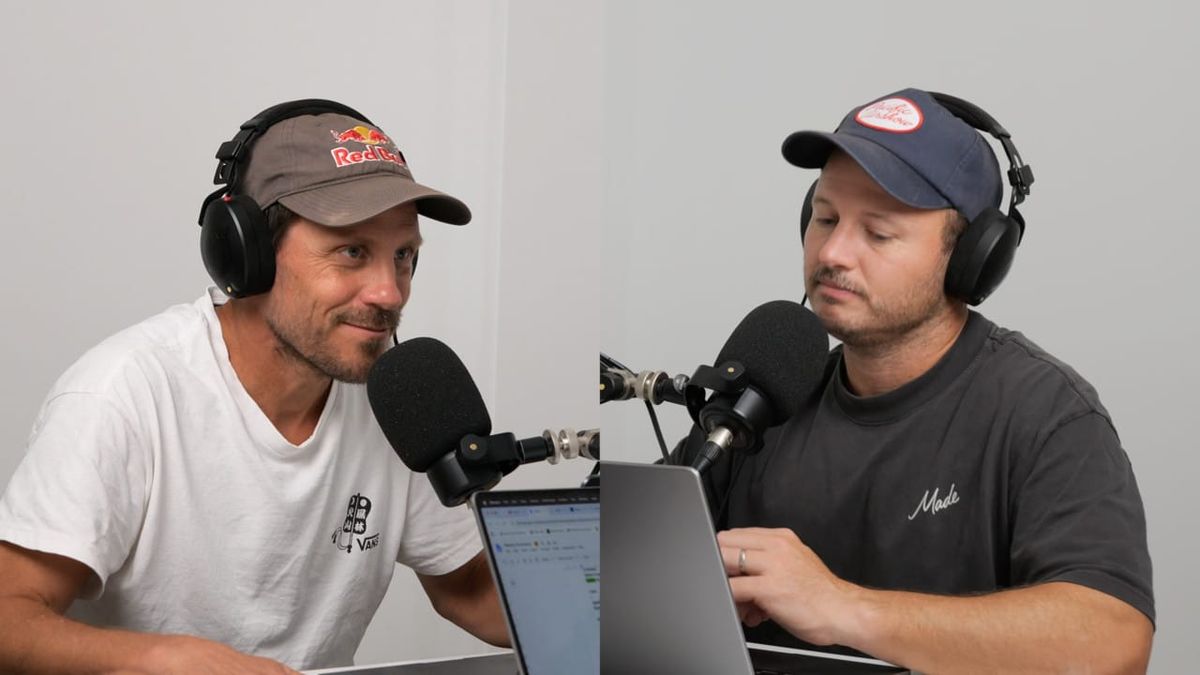
Jump to timestamps · Read the transcript
Two hosts, one week in Melbourne, and both of us got to meet Eliud Kipchoge. One of us did it without his phone talking over the GOAT.
Listen
After outlining his Melbourne half-marathon plan in episode 108, Courtney raced the Nike Melbourne Marathon half exactly as planned: conservative through 10K in 36:24 at a heart rate around 151, then 35:43 for the second 10K, finishing in 1:16:37. That was 64th overall and second in the 45-49s, and he insists nobody cares about the age group. Liam very much does.
He raced in the Alphafly 4, after warming up with an Alphafly 3 on one foot and a 4 on the other to feel the difference.
The verdict on Melbourne: it's a city marathon, with crowds every step through the streets and a stadium finish at the MCG that delivers. There's a trade-off getting 40,000 people out of the stadium, and they call it the Aussie marathon, the race where Australians race Australians to win.
Meeting Eliud Kipchoge
Then there's the Kipchoge effect. Courtney got to ask him his structure question on the finish line (he still runs twice a day, nothing has changed). Liam spent a morning with Kipchoge and Steve Moneghetti and came back with the training-journal questions and start-line mindset of the greatest marathoner ever, plus a Siri moment he'll never live down.
Also in this one: Izzi Batt-Doyle's national record in Chicago, Vincent Luis and Taylor Knibb at Kona, whether the Olympics should give every athlete the same equipment, and a parkrun grand final idea.
Local Legend: Declan Magill
This week's Local Legend is Declan Magill, who ran 2:41 in Melbourne pushing his daughter Hazel. Follow their journey at @runningforhazel, and donate to Declan's Dylan Alcott Foundation fundraiser.
Episode highlights
- Courtney’s 1:16:37 Melbourne half and the Alphafly 3 vs 4.
- Meeting Eliud Kipchoge: training structure, mindset and one Siri interruption.
- Melbourne vs Gold Coast, Chicago, Kona and the wider world of sport.
- Local Legend Declan Magill and the parkrun grand final idea.
Timestamps
- 0:00 — Courtney's Melbourne half: 1:16:37
- 2:12 — Alphafly 3 vs 4, one shoe each
- 5:17 — The Melbourne course and the MCG finish
- 13:43 — Does your age group matter?
- 15:18 — The Kipchoge effect
- 17:58 — Courtney asks Kipchoge about structure
- 20:16 — Melbourne: the Aussie marathon
- 24:31 — Liam's morning with Kipchoge
- 29:12 — Kipchoge's start-line mindset
- 33:54 — Meeting the GOAT
- 37:09 — Izzi Batt-Doyle, Chicago and Kona
- 42:01 — The world's most dangerous events
- 45:54 — Same equipment at the Olympics?
- 52:43 — Local Legend: Declan Magill
- 57:41 — Melbourne vs Gold Coast
- 1:01:09 — The best non-major marathons
- 1:07:40 — Chase 5 and the parkrun grand final
Does anyone care about the age group? Catch what listeners said, and Courtney's Frodeno reply, in episode 110.
Comparing your next start line? Explore our Gold Coast Marathon guide to course, pacing and race day.
Related In The Beginning episodes
- Caught On A Bike At 38K: Berlin's Fake PB And Melbourne Race Week | EP 108
- Nike Apex Vs Adidas Gear Shift, And Liam Says Sorry | EP 107
- Should A Marathon DNF Cost You 25% More? | EP 106
- Courtney's Marathon Debrief: 2:42:10 And Why Training Doesn't Lie
In the news
Kipchoge in Melbourne. Eliud Kipchoge won the Nike Melbourne Marathon on 11 October in 2:09:10, two seconds under the previous race record of 2:09:12 set in 2022. It was his first marathon win since Berlin in 2023. The course was redesigned this year to be flatter and faster, as one listener points out at 1:07:23. Australia's Thomas Do Canto was second in 2:10:35, and New Zealand's Camille French won the women's race in 2:28:25 (World Track).
A new Australian record. Izzi Batt-Doyle ran 2:20:38 for sixth at the Chicago Marathon the same weekend, 46 seconds under Jess Stenson's 2:21:24, with a negative split (Olympics.com.au). Amos Kipruto won the men's race in 2:01:09 (FloTrack).
Kona. Vincent Luis won the Ironman World Championship on debut in 7:47:27. Taylor Knibb took the women's title after defending champion Solveig Løvseth collapsed inside the final mile (TRI247).
Full transcript
Auto-generated transcript, lightly edited for clarity.
Read the full transcript
[00:00] In The Beginning, episode 109, where two people got to meet Eliud Kipchoge. Courtney Atkinson, how are you? Liam Flanagan, I am good. Yes, we did in the end. Both of us got there. Let's start before we get to Eliud. Congratulations on your half marathon. Thank you. Talk us through your race, talk us through your time. Let's talk about your race. There's so much to unpack here, not about my race, about the event. Okay. Because, you know, we've talked a lot on here about marathons versus marathons and
[00:32] what it would be like to finish in the MCG versus Gold Coast versus Sydney. I've got answers. Great. Before that, I'll let you know how I went. So 1:16 and some. 1:16 and some change? Yep. I'm not sure exactly what time it was. Which isn't far off what I think I picked for you. No, that's what I said. Claude told me. Oh, Claude told you. Okay. So Claude knows all. I think someone wrote in and said you predicted that last week, and I said, yeah, this is unfortunate. I don't know if it's a good thing or a bad thing, whether it's limiting.
[01:02] But what I did do, so I ran exactly what I said I'd do, 10K conservatively. And let me see what time, for those who are really into the running splits and stuff like that. Let's go all out for the kudos for everybody. I went 36:24 through 10K. Okay. With a heart rate of 151. So it's 3:38 pace at 151. So that was what I was kind of saying. That's probably around my marathon. I reckon around 150 is my marathon heart rate.
[01:34] So give or take, I've probably improved maybe four or five minutes on Gold Coast, but not as much as I was... As you were hoping. Probably hoping. You're still coming off that illness though a little bit. Yeah, it hasn't been great, but there's no excuses. If you aim to do something, you should get out and do it. 10 to 20K, so then a negative split. So I did the second 10K in 35:43. So 3:34 pace with a heart rate of 160, so an increase of 10 beats per minute, and then ran home with a 3:30
[02:06] in the last K or whatever. So it was solid. It was good. Yeah. I got to wear the Alphafly 4s. The new ones. Yeah. And, like, shoe review. So what I did on the Friday before, so they were sent to me, you know, Thursday, so I had three days to kind of go, should I wear them or not? It's a no-brainer once you try them. I was going to wear them, but what I love doing when you've got the old model of a shoe and the new one: I warmed up, I probably did like 8K jogging, did some strides, and
[02:39] then I went and got the Alphafly 3 and put one on each foot. Oh, wow. So then I went and did a couple of extra strides with the Alphafly 3 on one foot and the 4 on the other, and that's when you realise the technology advancement. And that's also where I think, I mean, you could do that across shoe brands as well, right? You could buy, I don't know, a new shoe that you wanted and try it against your old shoe from another brand and get a feeling for it too. But I think it really works well when you've got the same brand as well. But, like, the
[03:10] Alphafly 3, the best way I explained it, the 4 makes it feel hard. Really? The 4 has got so much more pop and cushioning. Yeah. But the biggest change they've made is just the stability through it. As a super shoe, you feel like you've got a lot more stability right to left, and those Air Zoom units at the front. Okay. And there's not as much... Remember when we've seen people walking around Gold Coast Marathon in Alphaflys and some of the other brands as well, we'd say, gee, they look like they're walking on stilts?
[03:41] I think it's a much more usable shoe for a lot more people now. It hasn't got that really... It's a lot flatter through the rocker, which for me running is a better feel. So you ran in the new Alphafly 4s. Kipchoge ran in the new Apex, which is a step above. We broke down Nike's range, if you're interested in hearing the exact breakdown. An extra Air Zoom unit on top of the Air Zoom unit I ran in. What's interesting about the Apex is that I have a friend who used to be a shoe designer, a shoe engineer, and did do some time with Nike.
[04:15] Oh, right. And because what's unique to the Nike Apex is the double-stacked Air Zoom unit, that's the technology, he reckons they were tinkering with that a decade ago. Wow. That's how long, and now for the first time, in the last fortnight, you're seeing this shoe arrive. Nike's been tinkering with this technology for a decade. Yeah, well, I'm jumping ahead a bit here, but Vincent Luis won Kona in a pair of Apexes. So on the same weekend, there was so much sport on.
[04:46] It was too much. I actually think that we need to stay on the marathon. Let's stay with the race for a moment. And granted, I only did the half. So that was my run. Mate, I just love being out there running again in these races, and the body for the moment is feeling healthy. And, you know, I'd love to be going quicker, but that's it. We're going to get to Eliud in a moment. Let's stay with your race and we'll kind of lump in the broader marathon course as part of it. Yeah, because it was together.
[05:17] Talk to me about the course. So it gets interesting here, because in my experience, I walked away just going, this was amazing. I had a great experience out there. And then in the last few days, I mean, before we... You know, I always go through our messages and everything, and I'm seeing a lot of negativity. I've seen the same stuff. Which surprised me. Well, it surprised me to a degree. And with a lot of the things that have been said, I kind of go, oh, yeah, okay. But when I was running it...
[05:49] So here's my take, let's start as a whole. Okay. I've got to preempt it with: I got looked after down there better than when I was a professional athlete. Right. Hands down. My experience with Nike down there was next level. Big old disclaimer from Courtney Atkinson. Yeah. You got the VIP Nike treatment. Yep. Disclaimer. Probably the best treatment. Going to an event to run, I didn't get treated like that as a professional athlete. Okay.
[06:19] Hands down. So I was with a group of a range of different people, but we had access to the Collingwood Football Club in the morning to go in, and, you know, you could warm up in there, leave your bag. That was right at the start line. Yep. I didn't have to go and pick numbers up and all of that stuff. I had all the gear laid out for me, everything you can imagine. But for any brand out there that is going to bring some people to an event that you're presenting, it's how you should treat them. You want them walking away as unofficial ambassadors of your event based on the treatment they received.
[06:52] So well done to Nike. So yeah, I cannot talk highly enough of the experience I had, and just the experience of Melbourne around the marathon as well. We put it up on the post: I had lunch with Jack Rayner, who's last year's winner, the day before. We had some of the Alphaflys broken down there, and he was talking us through when he got them, how he runs, and then what his preference was. We were talking about gravel bikes, and yeah, you know, it truly was amazing. So thank you. And then
[07:23] let's get into the actual race. Yeah, yeah, because what was interesting is I had no expectations of Melbourne, because we've sat here and talked about it a lot. You thought it would be amazing to finish in the MCG. And I, because I haven't done it yet, I still think it would be an incredible finish. And I was sitting on the other side of the table, in full disclosure, kind of going, I don't know. Yeah, because you're a Queenslander. I'm a Queenslander. I am biased and I'm a Queenslander.
[07:54] I'm a biased Queenslander. What came out of Melbourne for me is it's a city marathon. Now I know there's Sydney, there's New York, there's all these other marathons you experience. The city marathon is a different experience to Gold Coast. Very. Very different. So the last seven kilometres, so I did the half, once you get back into the city for the last seven kilometres, I think... Which is the same, a similar track to the marathon. Effectively we joined with the marathon, I think in Albert Park, at
[08:25] maybe eight-ish K, give or take. And for me that was awesome, because generally when I'm running races, not that I'm winning them anymore, but I'm still in the front bit, you know, there's three people, four people, we're on our own. Yeah. So I actually quite enjoyed being in with people. It felt like every single step of that marathon we had people around us, but that last 7K coming in before you got to the MCG was chockers with people in the city. Like, you
[08:57] really noticed the population density of being in a city in Melbourne, and it felt amazing, that whole run back to the MCG. Now, then going into the MCG, like you talked about. How was it? It was great to finish in a stadium. Okay. I ran in and went, yeah, this is a cool finish. And literally the lower level of the whole MCG on that side was full of people. Great. So I don't know how many that is in relation to numbers, but if you can imagine, if it was a track, they ran you like half, you
[09:30] ran 200 metres around the curve, and that whole curve was chockers from halfway down. Brilliant. Brilliant. So that's, oh look, maybe 5,000, somewhere between five and ten thousand people. Yeah, I don't know. But that definitely, to me, gave you the stadium feeling, which was unique. And when I finished, I looked around and turned around: this is really cool. A different experience to other marathons, but that is what makes that race, that gives it the uniqueness. But what gave it more uniqueness to me was,
[10:04] and I'm sure other people have experiences of this in other races, the city feel. Yeah. You're running through... The crowd was what? You're running on the streets of the city. The atmosphere was awesome the whole time. That's cool. That's cool. Can I ask, because we as human beings have an unbelievable ability to whinge and find negatives. Yeah. One thing that has popped up on my algorithm since is the medal presentation moment. Where were you handed your medal? Yeah, up in, well, for the half.
[10:35] So they did split the half and the full. Okay. But effectively you did the same thing, just in a different part of the stadium. You get sent down the tunnel. We walked up, walking up the steps, they handed you the medal and then took a photo. Right. Okay. But that was within the stadium, and then you went into what you've probably seen on social media. I can understand both sides here, because when I saw that, I was thinking, what was my experience like there?
[11:05] And I was like, yeah, you can't have both. You can't finish in a stadium with 40,000 people, and unless you want to go and sit in the grandstand, you kind of can't keep them all on the field, right? You do have to keep moving on. So there's a trade-off between finishing there and getting out. When we got out, it was more so around, I was thinking, if I had family and friends there, you didn't get any of that experience until you literally just popped out into the crowd on the concourse.
[11:37] Okay. And that was jammed. There's the trade-off. Okay. What I didn't experience, which I've seen on social media, was when the bulk of the marathoners were coming through and they were actually waiting to get out. It was like a line-up to get out, like cattle. Okay. But that's the trade-off. As you say, if we create this iconic stadium-type finish with a mass participation race like it is, that's the trade-off. Do you know what someone wrote in, and sorry I haven't got your name, but I think it was a really valid point: right at the moment, all
[12:07] of these marathons are selling out. Yes. In a perfect world there's no actual competition between marathons right at the moment in numbers. Yep. Everyone's selling out, you know, and whoever wrote in said, why can't they just help each other a little bit with... Oh, I saw this message. Help each other with logistics a little bit. And on the flip side, you know, I'm not organising events of that scale, but you're so concentrated on just trying to get your thing right at the
[12:38] time. Yeah. And there was a large company, I saw, who runs events in Miami. There's a global company behind running this. Hopefully they learn from it this year, but it sounds like it's been like that for a few years. The interesting thing for me running through in the half was, there was obviously someone like Seth O'Donnell running through a lot quicker than I am, and I was running through some of the aid stations going, oh, like... As in not being able to, or dodging people?
[13:09] Yeah, dodging. Because when the aid stations come, you've got the marathoners crossing the road to go have a drink, pretty much walking, and we're coming through running 3:30 pace, whatever that is, 18 kilometres an hour. There's a pretty big speed differential there. We've talked enough about the etiquette of aid stations, and yet fundamentally... Yeah, but I think I would be the same. If you're at 34K in your marathon, you're not thinking about someone else bolting through. Well, we'll put a pin in your race with this.
[13:43] Courtney Atkinson, 1:16:37. 64th overall. Oh, can you stop with this bullshit? No, 57th male across the line. I was having a conversation about this. Second in your age bracket. I don't care, Liam. I know you don't, but the In The Beginning family does, Courtney. I don't think they do. In the 45 to 49 age bracket, second. You're podiumed. I don't think anyone cares, Liam. You're an age grouper now, you know. No, no, no, no. Now let's go. Let's now look at... Just hang on. I had a discussion with someone about this the other day.
[14:13] What? No one cares, Liam. I think they do. I care, Courtney. What we care about, the reason we all run it, if you're worried about where you're racing against someone: time. The reason we're running on the road is time. You say this, okay. The reason you're running on the road is time. Let's not get bogged down in this, because I don't think we'll ever agree on this. You're speaking about this from the elite level, from someone who... I'm not, because I'm not running elite anymore. No, but with your background, your mindset, you have grown up in an environment
[14:45] where it's all about time and that's all that really matters. In my world, in the average human's world, where you finish in relation to the rest of your average humans is of relevance. And it's something that in Noosa in a couple of weeks' time, me and my humble jogger mates will be talking about: where'd you come in your age group? But you're going to compare yourself to your mates more than that. There's people in that race where I was like, I know where you ran, I ran them. They're the people I know. I don't really... Let's move on from this. Anyway, let's move on.
[15:15] This is one part of running you and I will never agree on. Let's now look at the Nike Melbourne Marathon and talk about the Kipchoge effect. First of all, the Nike Melbourne Marathon organisers must be just doing absolute cartwheels that Eliud the GOAT went out there and did what he did on race day and took the tape. Yes. It was a fairy tale from an event organiser, spectator, watching-on-TV-like-I-was perspective.
[15:47] And he worked so hard before he even got there. Oh. Because he was everywhere. He was everywhere. I won't talk about it just yet, but I literally saw he had a chat with Cathy Freeman today. Yes. Somewhere. But when you say right time, right place, I happened to just be standing there when he left the stadium, like literally his last interview. Do you have that audio handy? I do have that audio, but it's a little bit hard to...
[16:18] Do you want to go there? Let's hear it. If you haven't seen it on the Instagram already, check it out there. But this is, so Courtney, Eliud's obviously finished and won the full marathon. I believe his wife had run the half. Okay. So he was waiting for her. And you'd finished. Well, I finished, and then I was hanging out in an area with, I mean, Moneghetti and Jess Harley. Your VIP treatment had continued. It continued. And then, in full disclosure, I am the last person who would go up to anyone, knowing how much of a pain in the arse...
[16:52] Again, this is where we differ. How much of a pain in the arse... Let's just say it this way. I can only imagine he had been asked... How many people have asked him? 10,000 questions. Sure. And please give a photo or whatever it was. But this was your first time meeting him. Well, I got a tap on the shoulder, and his manager was there and the crew from Nike, and they were like, do you want to go and say g'day? And I'm like, well, only if, like...
[17:22] Of course. Only if... I can imagine he's had enough. This is why you'll never become one of the great run influencers, Courtney, because you're not prepared to get in people's face and interrupt them. Well, here's the story though. So I said, okay, well, yes. So I went over and had a chat to his manager before we went over, and he obviously at this stage said g'day. The only thing I had on me was my little camera I run with, my little Insta360 Go 3 thing, which is a tiny little camera,
[17:53] and the noise in that stadium is crazy. Actually, let's have a listen to the audio. "I always talk about how structure gives you freedom. Now that you've got less structure around your training and racing, how's that changed? Do you still have every day the same?" "Yes, I still run every day. I still run twice a day, every day, still leave myself, you know, free, and going on." I'm going to say, do you know why? Because it's very difficult to understand with the noise. I put subtitles on when we put it up. But I got
[18:23] to ask my question, and I'm literally holding my little camera. That's my professional media. Yeah. You know what the beauty was? I mean, he's winning the race still. Yeah, we're going to get to that. And he literally just said, yes, I still run twice a day, still treat myself, every structure, nothing's really changed. And he's still running just as quick. But what I did love is he then mentioned, and he said this across the whole week, his goal now is just to spread
[18:56] this love of running and impart it on younger runners. I had a bit of a giggle, because off the back of last week's episode, where I told everybody the question that I had submitted for the event that I went to with Eliud, you had said, oh, that's a pretty run-of-the-mill question. And then you met him and threw up a run-of-the-mill question. But I had a few people who messaged saying, I can't believe Courtney didn't ask if Eliud goes out on benders.
[19:28] When he had the opportunity. So, look, I'll tell my story in a moment about meeting him and asking that question, because it did get answered. Okay. What was your vibe of the man, meeting him face to face? The vibe was he's got time for everyone, but at the same time he's just, that's exactly what you'd expect. He's just like clockwork. Yeah. I mean, from the day you saw him, when was that, Thursday?
[19:59] Yes, I saw him at an event on Thursday morning. I reckon he didn't have a spare second the whole time up to the run. Yeah. While I'm thinking of it. So, yeah, it was like, what an opportunity, right? Of course. Yeah. And the fact he won, to have an opportunity to say g'day. What I realised about Melbourne compared to some of the other races as well is, take him out of it. Yep. This is the Aussie race. If you're an Australian elite runner, this
[20:34] is the marathon you can go and have an Australian run and win. Except when he turns up. So Thomas Do Canto was runner-up and Reece Edwards came in third, and obviously we saw the effort. For anybody that was not there and was watching it online or on the TV broadcast, Jimmy Whelan, the effort he put in, obviously bonked at the end, but it was the Aussies. And across the women and in the half. Sinead Diver came in... Sinead in the women's race. She was crushing it. And Seth winning the half. Because Sinead, like, she's...
[21:06] I don't want to say. No, she's in the 45 to 49 age bracket. I've got a feeling she's 48, 49. She'll be 50 in Feb. 2:30-something. That's amazing. It's incredible. Incredible. Incredible performance. So across the whole spectrum, it's really the Aussies' race, which I think is really nice too. It's Aussies racing Aussies. Okay, I love this. Let's put that stamp on this, because you and I talked a long time in the lead-up: Gold Coast is fast, Sydney is a major.
[21:37] What is Melbourne? It's the Aussies. I love that. It's the best of the Aussies. I love that. Aussies racing Aussies to win. I know Sydney's a major. Should the Aussie Marathon Championships be decided at Melbourne? Maybe. It's hard though, because it's the same weekend as Chicago. And you look at what Izzy Batt-Doyle did, and we'll talk about that a bit more later. But you're never going to get every runner to every race. But if you looked at it as a... I was just there watching, especially the marathon. Yeah.
[22:07] I was just sitting in the room pre the half, watching the marathon on the TV, and I'm like, this is an Aussie race. And a Kiwi, obviously. Yeah, yeah, with Camille French taking out the women's race. I was just like, this is an Aussie race. I wonder whether Athletics Australia would consider making Melbourne the marathon. It might have been previously. Anyway. What about you? Love that takeaway. I'm happy to stamp Melbourne as the Aussie marathon. I like that, Aussies v Aussies. My experience, first of all, my Melbourne running takeaway, because I got down there
[22:40] on the Wednesday and the first thing I did was go out for a run, ran around the park, ran around the Tan. You see a lot fewer nipples running in Melbourne. Not as many shirts off. Far fewer shirts off. That was my big takeaway. But I loved it. I went around there and I saw some run groups. I saw Hoka setting up for an activation. I saw Audible with a big run group that was out there on the Wednesday night. And you got that sense, even four days out, that this is a city getting ready for a marathon. And it felt great.
[23:12] I had my first shakeout experience. You did a shakeout run. Yep. So I went down. It was at an athletics store. Nike had joined with them for the morning. There were about 400 people there. That's the other thing Melbourne does have, and I think it's the nature of the city. I will say this, it would do boutique running stores better than anywhere else in Australia. Yeah, well, this was, I kid you not, there would have been 400.
[23:43] When we ran up, down one of those little side alley streets in Melbourne, it was kind of a bit rude at the same time, because I'm like, we've just taken over the street. Was there a DJ with a speaker, and were you carrying a flag? No, no, no. There was none of that. Sorry. No, no, no. I forgot. So much went on. This is why I'm glad we both got to experience Melbourne as a part of this marathon weekend. Was the Tan packed when you were running around it? Not crazy busy. I was running at probably about 5:30 in the evening, and
[24:17] there was a big Audible... it looked like they had a big activation that was ongoing. But I mean, I was motoring. So I loved it. And then the Thursday morning, and I can say all about it now, was with Bupa. Yep. They partnered with Eliud, and basically I was in a room with maybe 25, 30 other people, and Eliud was up on stage with Steve Moneghetti for 45 minutes.
[24:50] Okay. Doing a back and forth, talking about mindset, preparation, all that sort of stuff. And on a completely separate note, I got to meet Lucy Bartholomew, who I'd never met before and I'm a big fan of, and I had a great chat with Lucy. But I've made some notes. The first thing I will say is I was that guy in the presentation, because we all got given these personal journals from Eliud. It was hilarious, I was thinking about you, because Eliud brought three of his journals and
[25:22] said, here are my journals, you know, handwritten stuff. And Mona brought one of his journals that was from like 27 years ago, when he started. Oh, how good. And it was funny, because they were comparing journals on stage, and it's exactly like when we opened up your journals. It's that kind of, you know, session data, old-school handwritten journaling stuff. Just for clarity, not today's journaling. Not woo-woo journaling.
[25:53] No, this is just sports journaling. Like, this is my session. A training journal. This is how it felt. I slept shit last night. Yeah, but Eliud also has a shoe journal, where he literally, and this is with his relationship with Nike over the years, he said he would basically wear the shoe and then after every session score the shoe out of 10. Right. And so then every six months or whenever he would go and have a meeting with Nike, he would sit down and go, here, here's how I responded to the shoe in every training session.
[26:24] Did anyone ask the question, does he still hand journal or handwrite his sessions, or is he on technology? He still journals every day. Still journals every day. So that was kind of a bit of a theme of the morning: we all got given a journal that Eliud had personally signed, which is cool. I've never journaled before. And full disclosure, I had this... Hang on. Maybe we've got to call it something different, because... Well, this is an interesting...
[26:55] Let me get to what you're about to say, because I know what you're about to say. Okay, so Jackie Bell was there as well. For those that might know Jackie, ultra runner. And I asked Lucy, do you journal? She shook her head. And Lucy Bartholomew, you know, this is a proper ultra runner. She's like, I've never journaled. And Jackie Bell and I were talking about this afterwards. I said, do you journal? She goes, I've kind of always thought, and she and I were saying, journaling's
[27:26] a bit woo-woo, a bit agricultural, for lack of a better word. That's not the sort of journaling Eliud and Mona are doing. No, and that's why I was going to say, I think the word journaling... Journaling has a stigma. Well, no, it's the wrong word for what I'm assuming this is. Just trying to think what I would have called it. Journal. Yeah, what would you call it? Documenting? Logging? Someone's going to be sitting here going, you idiot.
[27:57] It's a log, a log book. Logbook. Logbook would be a better word for it. I think in the swimming days we did call them logbooks, and then I think training diary. Training diary. Training diary is what I would have called it. You know what's interesting? I would have put money on Lucy. Yeah. If you'd asked me who would be most... That's really interesting, because I see Lucy as being in that ultra space, quite alternative, in the outdoors and all that.
[28:28] I would have thought she would be someone who actually journaled. Well, no, I asked her, I said, do you journal? She said maybe I should start. Let's go with training diary. Training diary, okay. Well, we were given not so much a training diary as a journal, I think in the woo-woo sense of the word, because Eliud then said, I want you to start using these and I want you to ask yourself the questions. Everyone was frantically writing these notes down. He's like, where are you? Why are you running? And where are you going?
[28:59] He's like, if you can ask yourself those three questions as you go to journal, it's a good place to be. Sounds like you're also running for the right reasons then. So anyway, I've made some notes about things he talked about. Start line mindset: in his head before each marathon, he says, I'm the best prepared, best trained person on the start line. That's his mindset before he goes into the race. And he also said that on the start line, physical health can't help you. The only thing that can be an asset to you on the start line
[29:30] is your mental strength, your mental health and the mental preparation. I was like, that's interesting. So it is a proper athlete competitor mindset. I like this. This got a chuckle from the room. He said that the half marathon, everybody can run. He said the half marathon... You losers. Half marathon. I'll just put my hand up, I was one of them. He said a half marathon is for everybody, so he's always focused on the second half of the race.
[30:02] Yeah. He's always focused on the second half of the race. It was a good line. He doesn't think about speed when he's running. He believes he just listens to his body. Yeah. I believe the quote I wrote down was, I believe my body can handle any speed. My mind tells me I'm in good shape, based on his preparation. When he went on to record that sub-two-hour thing with the pacing and the negative splitting, he's like, when we got through halfway, I saw
[30:33] the time, but I let the pacers do their job. That's not for me to think about. So he doesn't sound like he wastes any energy thinking. Interestingly, I asked Jack Rayner, because he was one of the pacers of that two-hour project, did he get to spend time with him prior to that? And no, except for meeting him, they never actually... All the practising was generally done as a group prior, in the six weeks. They did have one trial run where he was there. But effectively, no, they were kept apart.
[31:05] And interestingly, it was to do with health. So much was invested. It was about keeping him healthy, not to be around people. In contact with as few people as possible. And then my direct question, instantly I thought, was it COVID times? No. It was still just about health. Yeah. So then the question that I told everybody about last week: Mona had three questions that he got okay'd to ask.
[31:35] Mine was one of them. Now this is where it got interesting. You're a winner. I was a winner. You're a winner. But this is where it got interesting, because if people remember, the question I submitted was, how has your approach to running changed now that you're no longer solely focused on winning races? Can I take a guess? Yeah. He is focused on... did he? No. What's interesting is that I don't know whether Mona chose to do it or the people from Bupa who were moderating this whole thing chose to do it. They softened it. Oh. Because that question could come across with the idea that now you can't
[32:09] win races anymore. So they softened it and it became slightly more about, you're still winning. Mona, I think, opened with, you're still winning races, but has your focus changed? It was just the way Mona nursed it in there. It's probably, I mean, in hindsight, right? Because then he went out and did what he did on Sunday. Well, even the question I asked, in hindsight, is probably... A little bit insulting. Yeah. Yeah. But here's what... and it's similar to what he gave you on
[32:42] the finish line. Basically now his focus is on the love of the sport, showing the next generation that if you work hard towards a goal, you can achieve it. And his mission now is to meet as many people as he can in the world, on the planet, through running, and to encourage them to run. Yep. When I walked away from it, because then afterwards this all finished up... And sorry, the reason I was that guy is because he gave us these journals.
[33:12] To go back to the journals that he gave us, everyone was furiously writing down and taking notes. And I was kind of like, I don't really want to, I want to be in the moment, paying attention a bit. And then I thought, oh, no, I've got to bring some stuff back to talk about on the podcast. And I'm sitting there with my phone in my hand, and I didn't realise, but I was holding the Siri button down. So in the middle of one of Eliud's answers, my phone's just gone, I'm sorry, I can't understand what you're saying.
[33:42] Oh no. I could have vanished into the floor. It was so embarrassing. Anyway, I turned the phone off. I'm like, anyway. But I got to meet him afterwards, got to shake his hand, had a photo. I don't want to overblow this and oversell it, but he is Dalai Lama-esque. There's a sereneness to him. There's a calmness to him. There's a slowness to him.
[34:16] With all the busyness around him, there is, and I imagine... I've never met the Dalai Lama, I'm not a religious person, I get the Dalai Lama represents things much, much bigger than Eliud Kipchoge. But if running is your religion, then Eliud Kipchoge is the Dalai Lama. I was describing him to someone and they said, yeah, he seems to levitate. There's just an etherealness to him as a person, and the way he carries himself, and the way he moves through a room and operates, and even the way he speaks. Again, not to
[34:51] get all woo-woo journally, but there is a sereneness to him as a human being, you know, and I think in what he's clearly trying to do moving forward for the rest of his running career and just his life. We are so fortunate, I think, to exist in a time where we get to experience Eliud Kipchoge. Yeah. What an experience. It was so cool. It was amazing. So it was definitely worth going down. Worth the adventure down. Meeting him, Bruce McAvaney...
[35:21] Oh, different. Very different. Because you've had both of them. Eliud Kipchoge. This year you've ticked off two big ones. Yeah, really, really different experiences. Similar, I guess there were similar feelings but different experiences, because... Well, you couldn't compare your trophy with Kipchoge. You were part of them. I'm never going to accept an award on the same stage as Eliud Kipchoge. No, Bruce is, for me, look, there are similarities.
[35:55] Both of them are reverential figures for different reasons for me. I think Eliud is just the absolute pinnacle and the top shelf of running. Bruce is that for sports commentary. I guess with Bruce, I've had the opportunity to ask for actual tangible advice, not kind of, run your life, marathon your life, enjoy, embrace, da-da-da-da-da. Bruce has been able to give me tangible, practical advice on how to be
[36:26] the best at my job. Yeah. But with Eliud, I look at Eliud, I'm a fan. I'm a fan. Whereas I look to Bruce and go, that's what I want to be. So slight differences. No, that makes sense. But I was interested because, I mean, when I saw you hanging with him, for some reason it reminded me of the night you were hanging out, because I left and then you were taking photos and hanging out. And you weren't taking photos, you were part of the group.
[36:58] Yeah. Yeah, different but the same. Very different but the same. But, look, Melbourne, congratulations. Well done. I think you've come out of this marathon with a stronger identity. Yep. Just interestingly, I couldn't help myself but have a look, because obviously Chicago was on. Yes. The same weekend. Without checking, where do you think Eliud's time would have come in Chicago? Before that, Izzy Batt-Doyle. Let's start with Izzy. National record. Let's start with Izzy. 2:20 bang.
[37:30] She took almost a minute off Jess Stenson's time. She's in great form. She's absolutely flying this year. Superb form. I mean, you look at LA 2028. She's still got two more years, or a year and a half's worth, if everything goes well and she stays injury free. So that was great to see. It'll be interesting to see, I mean, really super interesting to see, because we're now heading into summer, so out of road season, what she tries to attack next.
[38:01] I reckon he'd... oh, God, I have no idea. What? 12th? 13th? At the Chicago Marathon, Eliud Kipchoge's time would have had him finishing 18th. 18th. Because the winner, Amos Kipruto, came in at 2:01:09, and he was a minute 45 ahead of second place. It's a superb run. There was so much sport on. So much. We had Kona as well. Bathurst. Bathurst.
[38:31] Bathurst. Poor old Anton De Pasquale. But you talk about what we talked about, I think, last week or the week before, just how good the footy finals have been. Bathurst for the last two or three years has been right down to the last lap like this. Yeah. We had an interview on the radio show with Todd Hazelwood, who was the co-driver with Brodie Kostecki that won the race, and he summed it up beautifully. It was a great turn of phrase. He said, the mountain chose us. I like that.
[39:02] It's a very cool way of putting it. We were gifted. The mountain chose us. How good. You know, and I do like that phrasing. You know it in any sport: you can be the best prepared, with the best equipment, everything goes right, but you need a bit of luck. Yeah, I mean, I was at the airport watching that one. Kona. Kona. Some amazing racing. I didn't get to watch. My brother-in-law sent me the link to the women's race, and I haven't had a chance to sit down and re-watch any of it. Some of the best, I mean, over the years. But
[39:32] Kona did what Kona does. In the women's race, Taylor Knibb took it out again, but she was 90 seconds behind with a K to go, and the defending champion just collapsed. That's right. I mean, it all happened so quick. It's happened at Kona so many times. And then the men's race, to see Vincent Luis, you know, ex-world champion from ITU, ready to retire, come out and... just, yeah, you never know what to expect there. You've raced
[40:04] Kona? No, you've never raced Kona. I never raced Kona, so I never got to experience it. Why not? To be frank, Ironman just didn't suit me. I never really managed to race it. I'd raced a lot of halves really well, just never really crossed over to the Ironman that well. Is that an itch that sits in the back of your brain at all? Not at all. Okay. I mean, this probably goes to show personality again: if you can't do it well... The reality was I tried a couple. I won one Ironman distance, not an Ironman
[40:39] race, and then another one I was shocking at. But yeah, I just... But that's funny, because where this is hilarious is that out of the two of us, the person most likely to get to Kona is me, because I have an itch to do Ironman and find a way to get there, whereas you've got no desire to do it. Based on qualifications. I also know what work's involved to go and race it properly. That's the other hurdle. To go and race Kona properly, the amount of time Ironman takes.
[41:10] They don't call it the widow maker for nothing. Well, Liam Ryan, shout out Liam Ryan from Gold Coast Physio, who was over there racing it on the weekend. So, yeah. Do you know how he went? No, I don't have his results to hand. I should check him. No, hats off to anyone who, you know, we talk a lot about running and marathons and ultras, but anyone who's properly training for Kona or proper Ironmans while they've got family, while they've got a job and everything else life throws at them. Ten hours, six minutes.
[41:40] Wow, that's fast. Ten hours, six minutes. That's awesome. Congrats. It's his second time he's raced it. Hats off to anyone who does. I mean, the time that that will take. What else? F1 was on. Did you see World Gravel Champs? I did not. No. Was Josh...? No. He wasn't over there, for me. Don't know. But, again, just different sports showing up. That was over in Perth or somewhere in WA near Perth. F1 was obviously on. Red Bull Rampage, which is what I was tuned into. That was the big bike thing.
[42:11] Yeah, like the downhill. The scary thing. And last year there were some very, very, very close calls with the cliffs, and some of the best riders nearly going. No, thanks. Nearly like a repeat. I mean, it was on live in our night time, so I was sleeping. So I got up the next morning before the marathon and started scrolling through. There were some close ones. If anybody who's listening along doesn't know what we're talking about, Red Bull Rampage, you would have seen it.
[42:42] It's in Utah, effectively in the desert. You see these videos of these mountain bikers that are seemingly flying, and you're like, where's the course? Just look up Red Bull Rampage highlights and you'll know exactly what we're talking about. Yeah. No. Heart in mouth. The last sort of event that I'd ever want to be a part of. As far as events go, this is an interesting stream to go down. What organised events... So I'm not talking about wingsuiters going and doing projects or
[43:14] filming and that. I'm talking about organised events that are just batshit crazy. Le Mans... Le Mans, I'm saying that wrong. What is the island? It's a 24-hour motorbike race. It's on an island in England somewhere. Where is it? Well, there's Le Mans in France. No, no, no. That's a car endurance race. The Isle of Man. Isle of Man. Sorry. The Isle of Man. Sorry, sorry, I'm talking about the motorbike race on that, where people die regularly. 100%. Yeah, Isle of Man. If you watch the highlights of that, do yourself a favour, go, if you haven't seen it. That is crazy, crazy. Red Bull Rampage is up there. I
[43:48] mean, these guys, if they come off the wrong way on these jumps, they're off the cliff. Oh yeah. I was just going to say, it's crazy. I'd hate to be on the back end of dealing with the crisis comms. Oh, God. I mean, it was cancelled because of the wind this year, the weather came in, but year to year there's always something that happens. It is one crazy event. And then I was thinking, you know what else I've been watching this week? What's that? The World Freediving Championships. You know the
[44:20] ones? Yeah, you know, the ones where they literally see how deep they can go. So I think I was watching one guy go 34 metres, and then as they're coming up, as the lungs expand again, and they're about 10 metres from the surface, some of them just black out. They're the three. Sure, there's others. They're the three this week that I'm just going crazy for. So I've just asked super intelligence, as Donald Trump refers to it, the events where the athletes face the greatest danger.
[44:53] Where? What? The Mille Miglia, which is an Italian road race, a motor race. Obviously similar to... The 24 Hours of Le Mans, the endurance race. The Dakar Rally: since 1979, approximately 79 deaths have been associated with the event. Yeah. Yeah, I mean, yes, I can see how... But the number one is the Isle of Man TT. Yeah. That you're referring to, with more than 150 rider deaths since 1911.
[45:27] So, yeah, it's speed. Don't get me wrong, speed. Dakar's bloody... I mean, if you talk to Toby Price or anyone, the amount of broken bones and other things, and he has had to stop in the race with someone dead. Oh gosh. You know, like, there's... That's heavy. You know, effectively, yes, I can see how that is in there. That's heavy. But I'm still going to stick to my three for this week, because that's what I've been watching. Dakar's not till January. That's heavy stuff. Hey, while we're talking about hypotheticals, I got into an interesting conversation with
[46:00] my friend who used to be the shoe designer with Nike. Okay. Who told me about the Nike double stack stuff, the technology that's in the Apex. We got into an interesting conversation about Olympics and technology. And you and I have talked about the idea of whether coaches should be restricted to coaching for their country of origin at the Olympic Games. What would you say if the Olympics came out ahead of Brisbane 2032 and
[46:32] said all athletes in all sports must use the exact same technology? Forget about the implications for sponsorships and all the rest of it right now. But for the most part, you could argue swimming already does this. You could argue there is essentially some technology difference in the suits, but that's probably as close to it as you can get. What about... And for anyone in track and field, I'm going to sound like an idiot saying this because it could be right or wrong, but I'm thinking discus, shot
[47:05] put. Maybe. Javelin? Maybe they're as close to it. Yeah, they all have to use the same physical tools. Because pole vaulters take their own poles. They have their own poles. And I'm assuming... No, they would. I'm sorry. I would say they would have to be provided by the Olympics, because they have to be a certain weight. That is the whole point. But rather than get down in the... you can look that up. But let
[47:36] me explain to people who are listening. The idea is, if Noah Lyles was wearing the exact same shoe as, what's his name? Fred, is it Kerley? I've forgotten the American sprinter's name. Yeah. Fred Kerley. Yeah. You're saying if everyone had to wear a stock shoe? Yes. Would the result change?
[48:08] Or if... and we talked a bit about Sabastian Sawe being in that shoe running for Adidas. Ultimately, whatever shoe the best athlete in the world chooses is likely to be the shoe that arrives atop the podium. But what if at the Olympics the shoe was blank and you had this purest version of sport? I love the idea.
[48:38] I mean, I love the idea of everything being equal, so it becomes just you. Yeah. Like, how would that go for triathletes? Whereas if they went, here's the bike you're all riding... I mean, let me ask you, do you think it would change the result? Probably not. Okay, probably not. So let's go back to the most recent Olympic Games in Paris. You think Alex Yee still wins that over Hayden? Yes. Okay. On the day. On the day. On the day, yep. I mean, the
[49:09] certain pieces of equipment might suit someone differently and vice versa. There's always... probably not that big a change. But I think the technology at the top, if you took all the shoes at the moment. Yeah. The top lot, they're all much of a muchness. So this is a conversation, just going back to the shoes at the moment. The conversation I had the other day, who was it? Someone said to me, oh, someone ran in the new, I think they were Mizunos.
[49:40] They're amazing. And I'm like, okay, but last week it was Puma, they were the best. And then everyone looks at, like, rubber. This week, you know, the Apex had just won Kona, and Kipchoge, you know. Where do you draw the line with chasing? You know, for the normal person, I'm talking elites at the moment, but for the normal person going out there, there's a point where good enough is good enough. Of course. And the reality is, if they keep changing month to month, if, you
[50:14] know, social media or whoever's marketing is telling you this one's better, this one's better, this one's better, my conclusion is you're actually better to get to the brand you know and stick with some consistency and feel. Yeah, I agree. Because if you keep jumping ship from one to the other to the other, I think that's where... Yeah, I agree. That doesn't make sense. I mean, that's me. It just doesn't make a lot of sense to me to keep doing that. You're just going to be chasing forever at the moment. One more, to wrap up the Olympic equipment chat. The conversation I had with my
[50:47] mate about this was, he was saying that tennis rackets would be very interesting, because the style of tennis that players play dictates their racket setup in such a significant way that, you know, Rafael Nadal might struggle to play with Roger Federer's racket, such is their form of tennis, because Rafa's racket... But wouldn't it have a lot to do with string tension? Yeah, part of that. Yeah, and that's what I mean, all of the setup there. Oh, so you reckon you give them, like, literally a... Yeah, give them an off-the-shelf racket.
[51:18] Here. Here's a... Well, here's an idea. Just get on Amazon and go, bang. You know. Yeah. Just 20 of the same. Exactly. Yeah. I mean, I don't... The one where I thought it would be the most revealing, the Olympic sport: equestrian. They've all got to ride the same horse. Because are you giving the medal to the horse or to the person? Because if you're giving it to the person, put them all on the same horse. So you end up with bucking bulls.
[51:49] Rodeo. Rodeo. Take it to the Olympics. You know what? Show jumping on the same horse becomes... Brisbane 2032, if you're going to put an exhibition sport out there, we wouldn't go back. Like, if we're talking about, look, don't get me wrong, Brisbane 2032, my number one for exhibition sport must be surf lifesaving. For me, I will be pushing that boat out for the next five years. I don't mind rodeo as a second option. Hey, Queensland.
[52:19] Rockhampton can get there. Hey, Rocky, we'll give you that. You can give us back the rowing so we don't have to row with crocodiles, and you can have rodeo. What about that? You'd be out. Oh, geez, it'd be good. Imagine rodeo at the Olympics. You've still got me thinking of show jumping, same horse, bareback. Well, no, you can still use the equipment. You can still use a saddle, but they've all got to be on the same one. Anyway. Okay, okay, okay. Where do we go? Hey, I did want to... Each week we love all the
[52:50] messages we get, and we get a lot of proposals for different things and people, and we try to be consistent in what we do. But this one stood out for me in Melbourne, and there's two reasons this one stood out. And I've got some audio for some background, which I'll get to. But this one, who sent it to me? Jordan Ryan sent it to me, and he said, this has to be your local legend of the week. Go for this week. And his name is Declan Magill. He ran the Melbourne Marathon in 2:41,
[53:25] pushing his daughter, who has cerebral palsy. I can't run 2:41, Liam. Declan Magill, 2:41, pushing his daughter. That's crazy. So here's a little bit of background. Yeah, please. Because I reckon it's worth spending some time on, because this actually... When I listened to this... You're not going to make me cry on this podcast, are you? Possibly, because I nearly had a tear in my eye. Okay. "Hazel is my daughter. She's three years old. She was born with significant brain damage, and she
[53:58] has severe cerebral palsy, so she can't walk, she can't talk and she can't eat food. On top of that, she's also profoundly deaf, so we communicate with Hazel through eye gaze. Medical stuff aside, Hazel's a sweet little girl with the biggest smile and the biggest heart. We love her to bits. Running for Hazel began shortly after Hazel was born. I set up a GoFundMe to raise money for Hazel, and I ran the Sydney Marathon. During the hardest kilometres, I think back to the time spent in hospital.
[54:29] I put myself in that place and I just think of how hard those times were. And I also think about the challenges and the struggles that Hazel goes through, and that this doesn't really compare to that. After learning Hazel's story, I hope that people understand that even if you have significant challenges, you can still accomplish incredible things. And I also want people to understand that just because you're disabled doesn't mean that you don't have a place in the world." Did it get you? Did it get you?
[55:00] Yeah. So, yeah, for multiple reasons, but it's just impressive. This is super impressive as a runner, number one. But number two, the bond he's able to have, to do it pushing around his daughter. When I saw this this morning, this was my highlight of the Melbourne Marathon. I was like, this is great. That's really... It's so hard to talk now off the back of
[55:33] that for me, because, I mean, Declan, like every parent, wants to bond with their kids over shared passions, and obviously Declan's found this way to connect with Hazel, running with her, and to go out and do that. And yeah, man, we talk, we love running. That's our starting point. We have some fun around, you know, the things in the running world that
[56:05] we don't like as much. And I spoke a bit earlier in the pod about Kipchoge and his attitude towards running and meeting people and getting as many people running and involved. For all the noise that exists around running, when you hear people like Declan, it's like, ah, just disconnect. Just forget about all the noise, forget about all the crap, forget about the negativity, the competition. You know, that's awesome. Thank you. Thank you for finding it. Thank you for sending
[56:39] it in. No, it was... Sure, yeah. So thanks, Jordan, for sharing, because I missed that one on the weekend, but that's a highlight. Man, Declan, you're a star. You're an absolute star. And I don't know if you've run it before, but get on up to the Goldie next year. Let's get him up here. Let's get him and Hazel up here. Where's he based? I'm having a look at his Instagram now. God, I'd love to talk to him. Declan, if anyone knows Declan... He looks like he's run Blackall. Has he? He ran Blackall 100.
[57:10] Is he Queensland-based? He was fourth overall at Blackall 100 last year. Jeez, he's a weapon. Anyway, shout out, Declan. Yep, yep. And so I'll keep going with a couple of ones that came in. Can you do less emotional ones, please? No, I love it, but it makes it very hard to talk, because I'm a crier. Well, that got me when I was recording it this morning. I was like, Jesus, what a story.
[57:40] Yeah, well done. This one came in from Shane. Hey, guys, hope you're well. After doing Gold Coast Marathon in 2025 and doing Melbourne this year... I wonder if he's a Queenslander... he's saying Gold Coast is the clear winner. The whole weekend and the post-marathon activation was miles ahead. And he said the thing with Melbourne is, 100%, the MCG makes that event, and also the people and the volunteers. Okay, that's good to hear. Yeah. That's good to hear.
[58:10] It is a running city, isn't it? It is. Like I said, right from that shakeout I went to, the first shakeout I've ever been to... In all honesty, I'm still not 100% sure why. Okay, you don't have to be a shakeout guy. Why? Yeah. If you're trying to warm up, it's probably not ideal. Yeah. But I can also see why everyone wants to be together and experience the city you're in. So I get both sides of it. But, yeah, literally, that was his thoughts.
[58:41] I'm going to say Gold Coast do an absolutely amazing job. The organisation is perfect. The experience when you leave, getting through, on the Gold Coast, because they've got such a wide open area... It's horses for courses, mate. You're on the Gold Coast. It's different courses, right? This is from me thinking about it: every event can't have everything. What we have here on the Gold Coast is very, very different to a city marathon.
[59:12] Yeah. And so to anyone out there, I'm now saying, I was biased towards Gold Coast, I'm now saying, go and experience both sides. Yeah. Yeah, and it has 100% turned me around to wanting to experience the different types now. And I don't know whether... it probably makes me want to experience a marathon in a big city like Tokyo or somewhere like that, which would be really interesting. I think you've nailed it there: experience.
[59:45] Go and experience it. This is where, and again, what underpins this podcast is love of running, the experience of running, going and doing stuff. And I mean, I'm literally in the process of sorting out a Hyrox entry for Brisbane next year, because I want to experience it. Have they just expanded to... I don't know if they've released this. I might be giving... Oh, breaking. Breaking, give it. Go. Or is it just the inside word? I've just read... Allegedly. Allegedly. Okay, allegedly there's expansions on the cards.
[60:17] I don't know. I don't know anything. But, hey, you know. While you fact-check whether or not you're allowed to say anything... No, I don't know. I am signing up for Hyrox because I want to experience it, and I'll come off the back of Hyrox hopefully with an experience that I can then compare to other things that I've done, and then you choose whether you want to go back and do it again. You've run Melbourne now. You've run this city marathon. You've run Gold Coast Marathon. You have an understanding of what is great about the two and what is
[60:50] different and better and worse and all the rest of that. And we could talk about it. And now you can choose to run again. This is how you figure it out. There's no point sitting in the cheap seats and having opinions on this stuff if you're not going to go out and do it and come back with evidence from your experience. Well, here's some ideas. Brooke Spice, this is just a good segue, Brooke Spice had shared this post about the best non-major marathons on the planet. So I'll run through them.
[61:21] Valencia. I mean, that's the fast one. Everyone knows Valencia. Amsterdam. Okay. Flat, fast again, would be down the river. Definitely have a good night out after it. Yeah, you'd have a great time. Melbourne, number three on the list: redesigned, finishes in the cricket ground. Seville in Spain. Yep. Another one, flat. These are all very fast. Stockholm. Frankfurt. Okay, well, this one's different. Grandma's Marathon: Grandma's, point to point along Lake Superior, sells out in under an hour every year, spaghetti dinners included. So
[61:55] I like the idea. It's in Dull-off. Dull-off. Jeez, you're doing well here. Duluth. It's pronounced Duluth. Thank you, Liam. Grandma's Marathon in Duluth, USA. Have you heard of Duluth before? Were you seriously struggling to just pronounce grandma? No. I said grandma. I don't know if you did. I think we'll check the tape there. Okay. Keep going. San Francisco, which is a given. Golden Gate Bridge. Hamburg. I mean... Very flat again. I've had so many great events in Hamburg.
[62:25] Yeah. Copenhagen. Cool city. Rotterdam. Cool city. Big Sur Marathon in the US. Big Sur, okay, this is a bit different. It's got 2,000 feet of climbing, so it's sharp. Highway along the cliff sides, into the redwoods. So it would look amazing. That would be unbelievable. That would be unbelievable. Gold Coast makes the cut as well. Okay. Again, flat, fast. 62 metres of total elevation. Because this is, I'd say, an international site I'm reading. Yeah. It's @nextmarathons, the Instagram handle.
[62:58] 60% of finishers report a personal best at Gold Coast. Makes sense. Rio. Rio. Rio would be amazing. I've raced a lot in Rio. It's always a fun city to go and race in. Seoul. Yep. Athens. Athens would be it. Athens would be great. I think the original, right? Athens would be cool. I wonder whether they run... It does, to the stadium. Again, experience. Runners take a marathon oath before the start.
[63:30] Oh, Deeks does that. It's Deeks. Deeks is... Why have they ripped Deeks off? By the way, can I just... You mentioned Deeks. Real fanboy moment for me. I had a quick chat with Mona after he did the Eliud Kipchoge thing. Yeah. And he remembered me from the marathon, because he comes up and does the broadcast. And I was just like, oh. But this is, again, I very much still look at myself, when we go into these areas, as a fan that's been let in the side door. Yeah. I know I've been doing stuff in this space for a long time
[64:02] now, but I'm like, athletically I haven't earned my way into any of these rooms. So when I get in these rooms, I still really feel like the work experience kid that's just been allowed to come in, sitting with all the... The intern. Yeah. That's how I feel. So when I went over and introduced myself to Mona, he's like, yeah, yeah, I know who you are. Oh my God, Steve Moneghetti knows who I am. Didn't know who I was. Shut up. Anyway, sorry, that was it. Which one's last on your list? Marrakech Marathon. Marrakech, that was the end. Morocco. But it was interesting, I had a look at
[64:33] the most commented missing ones: Rome, Mexico City and Paris. Paris is Paris. Hey, on that, isn't there famously, after the Olympic marathon, a day that the public get to run the course? Is there? I believe so. I believe Peter Bedell, who's a journalist with the Courier Mail and is also a good marathon runner, I think he's like a 2:40, 2:45 type runner, ran the Paris course the day after the Olympic marathon.
[65:06] I don't know if it's a tradition for all marathons. It certainly happened in Paris after the Olympics last year, but I don't know if it's a tradition. I assume it would happen in Brisbane if the course is set, which we're still waiting on Michael Shelley to officially tell us: where the marathon's going to be, and if he's going to sign off the course. I haven't heard that one, not sure. Hey, you know what event we also missed? Gold Coast 50 on the weekend. The GC50. It was 10,000-plus people. I saw the video. I didn't realise how big an event it's become.
[65:36] Huge. And they want it to be bigger next year. Well done to the organising team. Runners. Running is... Running is. Hey. How many did they get? 10,000. 10,000 over the weekend, I believe. But I always thought, this is how naive I sometimes am on this stuff, I thought you still just ran along the beach path. No, they've changed it. They've shut down the roads. Yeah. It's like a proper... Yeah. Honestly, I thought you just ran the beach. The promenade. Pretty much, yeah. Like when they do the Kirra parkrun.
[66:08] I was thinking it was still like Kirra parkrun, just run further down. So yeah, for those interested, my mistake. Well done to the GC50 team. That is a great event. Just quickly, the Olympic tradition you're actually referring to is running the marathon as the final athletics event of the Games, rather than running a second marathon. Maybe. No, I'll look into that more and get back to you. I promised I'd give a shout out to Mon. She was going down to run the Melbourne Marathon, but she's gone through some back pain and a whole range of things.
[66:39] So shout out, Mon. Mon, she didn't get to run. Oh, bugger. But hopefully you recover. Feel better, Mon. Super quick for you, and then we'll leave some of that stuff to next week. We've got it. It was a big run sheet. It was Everyday Runner who earlier on said, why can't the big events all learn from each other rather than competing? I had it in there, yeah. They all sell out anyway. Melbourne is my home marathon, but surely they can learn from events like the Gold Coast. Melbourne has wave letters, but they don't enforce them, so people in wave D can go straight up into wave A.
[67:12] Oh, I did experience this. This causes more congestion, but might not have been as noticeable up in the elites. Plenty of other things too. Secondly, I love the story of Eliud winning and setting a new course record, but it shouldn't be a new course record anyway, as the course is much different to the previous course. Interesting. Didn't know about that. Yeah. Yeah, I mean, I didn't get to run the whole marathon. Oh, well, I chose not to run the whole marathon. As Eliud Kipchoge said, half marathons are for everybody. We'll finish here. We'll finish on a local note, because I like this one.
[67:44] Gnome shared this to us, but it's come from Jordan Has The Runs, and it's called Chase 5. This might be for some of our listeners. Have a listen to this. "If you're interested in trying your first running race, but you're worried that everyone is going to disappear and leave you in the dust, then I've got the race for you. This is Run Community Clubs' Chase 5, a local 5K where the slowest runner starts first. And last weekend, that was me. Everyone starts based on their predicted time, with the fastest runner leaving last. The idea is that everyone reaches the finish line around the same time, and
[68:16] whoever crosses the finish line first wins $200. After turning around at halfway, I got to see everyone else coming towards me in the other direction. And then it became a chase, right down to a mad dash across the finish line. I came ninth and set a new 5K personal best, and nine of the 20 other runners also set 5K PBs." That's really cool. It's local. The old handicap system. I wonder whether parkrun... this would work. Okay. You're normally throwing out schemes, but here is...
[68:47] This has just come off the back of this. I think with parkrun, if you've got a consistent membership, or I don't know what you call a parkrun community... Yep. You've got all of the times backlogged. There's no reason a local parkrun couldn't, every few months, go, today we're doing a handicap race. Just do it once a year. Once a year. The final of parkrun each year at your local community. I love it. You've got the times. You've got the average of times for all the years, and then just set
[69:17] off who's the benchmark. Now, yeah, I love it. Can I piggyback on this? Can I jump on and expand this idea? Because I think it's great. The parkrun Grand Final weekend, where your local parkrun has an event. You must have competed in that parkrun at least 10 times that year in the lead-up. You must have 10 times logged to show that you are not just a ringer who's going to turn up and try and take the chocolates on the day. 10 previous runs that year, logged, will then set your handicap. Because parkrun is all about participation, if you arrive on the
[69:49] day without the necessary runs, you can still run, you're just ineligible to win. Oh, you're just automatically backmarker. Yeah, better. If you turn up and you haven't run 10, you can come, but you are automatically set alongside the fastest runner in the race. Good. Plus 100. Just in case. This is a great idea. I reckon. That's a great idea. Easily implemented. I like that. parkrun people.
[70:19] Send us the invoice. Bring in the grand final weekend. All right, on that local note, get out there and enjoy your running. Thank you to everybody that has messaged us. I'm sorry if we didn't get back to you. There's been so many messages coming in around Melbourne and the things we've been doing. We're going to try and get back to as many of you as we can. But get out there, enjoy your runs. We'll see you next week. See you next week.